7 Best Explainable AI Patent Drafting Tools in 2026
Esgenix Team · Published September 4, 2026

On this page
- What is explainable AI patent drafting?
- 1. Esgenix: Best for a fully reviewable, examiner-ready draft
- 2. Solve Intelligence: Best for visible reasoning inside claim charts
- 3. DeepIP: Best for an auditable change history inside Microsoft Word
- 4. Patlytics: Best for analytics-grounded, audit-ready outputs
- 5. Qthena: Best for human-in-control workflows backed by Questel data
- 6. Ankar AI: Best for evidence-backed reasoning across the lifecycle
- 7. PatentPal: Best for predictable, claim-driven specification and figures
- Comparison table
- How to choose the right explainable AI patent drafting tool
- See how the council drafts
- Frequently Asked Questions
By the Esgenix editorial team
Explainability is now one of the first questions patent teams ask about an AI drafting tool, and it is a professional requirement rather than a preference. A patent attorney remains responsible for every claim filed, so a draft that cannot show how it was produced is slow to review and hard to defend. ABA Formal Opinion 512 says lawyers must understand and review generative AI output before relying on it, and the USPTO's 2024 AI guidance keeps practitioner responsibility in place for AI-assisted submissions.
Two pressures make this urgent. The first is volume: generic AI output is now cheap enough that reviewers see more drafts of lower average quality, and time saved in drafting is spent again in review. The second is fatigue: when every tool asserts quality and none shows its work, teams stop trusting the assertion and re-read everything by hand. Provenance and explainability are what turn an AI draft back into something a patent professional can check quickly and sign.
The standout options include Esgenix for a fully reviewable draft with a redline audit trail and invention-claim mapping, Solve Intelligence for visible reasoning inside claim charts, and DeepIP for an auditable change history inside Microsoft Word. Each tool below takes a different route to the same goal: letting an attorney see where claim language came from and why it changed.
This guide breaks down seven AI patent drafting tools that make their work reviewable, comparing how each one surfaces its reasoning, its data-handling posture, and who it fits best. None of these tools publish pricing; all are demo or trial gated, so evaluate them on capability and fit rather than list price.
What is explainable AI patent drafting?
Explainable AI patent drafting means the tool lets an attorney answer three questions without guesswork: where did this claim language come from, why did it change, and does it trace back to the invention disclosure. In practice that shows up as citations to source, a visible edit or redline trail, and a mapping between generated claims and the underlying disclosure.
Those signals matter most for antecedent basis and written-description support, which are common grounds for rejection under 35 U.S.C. 112 and are assessed against the standard in USPTO MPEP 2163. A tool that shows its work lets an attorney catch an unsupported limitation before filing rather than after an office action.
Explainability also builds trust across a team. When a junior associate drafts with AI and a partner reviews, a visible trail turns "trust me" into "here is exactly what changed and why," which shortens review and reduces variance between drafters.
1. Esgenix: Best for a fully reviewable, examiner-ready draft
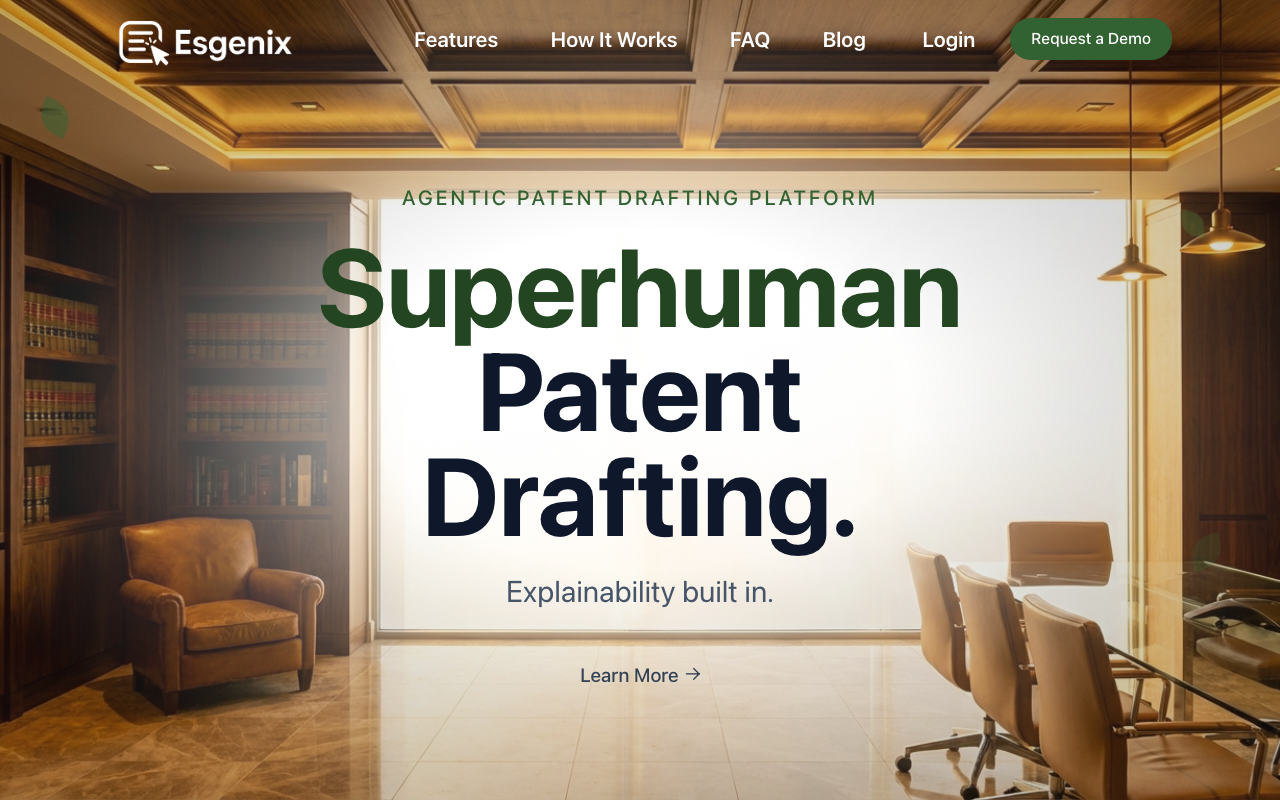
Esgenix is an agentic patent workflow platform built on a multi-LLM council, and explainability is its central design goal rather than an add-on. Three or more temperamentally diverse models draft and debate claim language, then drive the draft toward a filing-ready state. The drafting workflow provides an explainable redline audit trail with provenance to source, so an attorney can see how claim language was derived.
What sets it apart for review is invention-claim mapping. Generated claims are tied back to the original invention disclosure, so a reviewer can confirm each limitation traces to something the inventor actually disclosed. Draft-time checks cover antecedent basis, specification support, clarity, and drafting consistency before filing, targeting issues that can draw 35 U.S.C. 112 rejections.
Mapping can be overdone. A tool that binds every limitation so tightly to the disclosure that it will not propose broader or alternative protection has traded one problem for another: the risk of invented substance falls, but so does the attorney's room to improve the claim set. The useful position is mapping that shows its evidence while leaving claim breadth under the attorney's control, so a reviewer can widen, narrow or challenge scope on the record rather than accepting whatever the mapping produced.
On data handling, Esgenix is secure cloud-first by default with AES-256 encryption at rest. Data transmitted between the user, browser, application and backend services is protected through secure encrypted communication protocols such as HTTPS/TLS. Invention disclosures and drafting artifacts are not used to train models. Esgenix operates under zero-data-retention agreements with its model providers. A customer-controlled storage option is available for highly sensitive matters. Founded by patent practitioners, AI architects, and technologists, with a founding team carrying 65 years of combined IP, technology and commercial experience and more than 1,000 patents handled, it is a newer entrant currently focused on agentic patent drafting, drawings, and integrated search and analysis. It does not yet publicly offer prosecution execution or detailed analytics.
Pros:
- Redline audit trail with provenance to source across the whole draft
- Invention-claim mapping ties every claim to the disclosure
- Adversarial multi-LLM council surfaces weak or unsupported claims early
- Draft-time checks cover antecedent basis, specification support, clarity, and consistency
Cons:
- Newer entrant with a shorter public track record than incumbents
- Does not yet publicly offer prosecution execution or detailed analytics
Best For: Teams that want to see and defend how every claim was drafted, limitation by limitation, with examiner-facing checks built in.
2. Solve Intelligence: Best for visible reasoning inside claim charts
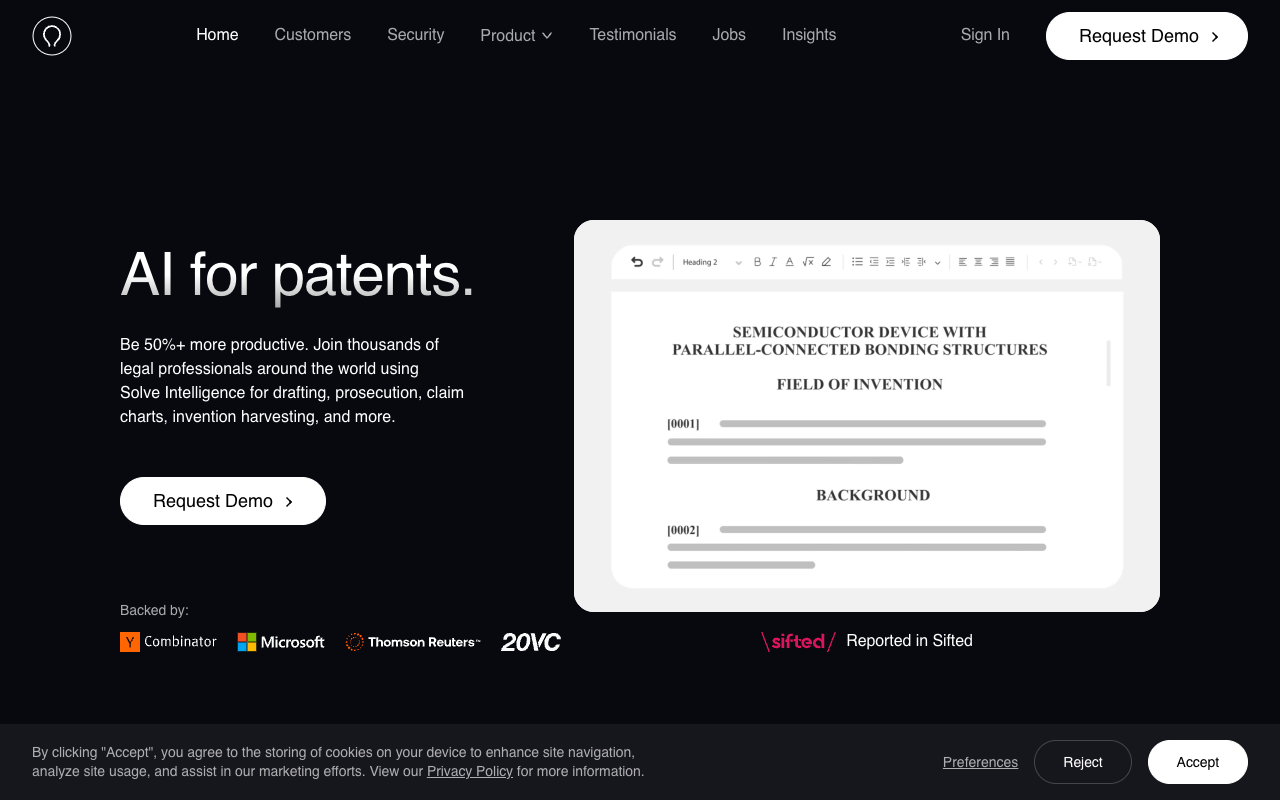
Solve Intelligence is a widely adopted patent drafting platform that reports use by more than 700 IP teams across six continents, and it is backed by Y Combinator, Microsoft's M12, and Thomson Reuters Ventures. It works alongside the attorney in a browser editor and adapts to an individual drafting style.
Its explainability shows up most clearly in claim charts. Each cell includes multi-source citations, and columns can be expanded to show the tool's reasoning, which gives attorneys a transparent view during analysis and prosecution. On the prosecution side, it drafts office action responses with citations to file wrapper documents and case law.
The trade-off is scope. Solve centers its transparency inside claim charts and prosecution rather than a single whole-draft audit trail, and its public material does not describe a multi-model cross-check of the kind Esgenix runs.
Pros:
- Claim-chart cells show citations and expandable reasoning
- Strong prosecution support with file-wrapper and case-law citations
- Large, established user base across many jurisdictions
- Handles figures, chemical structures, and biological sequences
Cons:
- Explainability is centered in claim charts rather than a whole-draft trail
- Public material does not describe a multi-model cross-check
Best For: Teams that want visible, citable reasoning inside an interactive drafting editor across drafting and prosecution.
3. DeepIP: Best for an auditable change history inside Microsoft Word
DeepIP is an end-to-end patent platform that works inside Microsoft Word, which lowers adoption friction for teams already drafting there. Its patentability and novelty analysis is described as claim-level and mapped to prior art, and its AI Reviewer logs every modification in Word Track Changes with author, timestamp, and rationale.
That native change log is a practical form of explainability: reviewers see exactly what the AI changed and why, using a tool they already know. DeepIP also states a strong security posture, including ISO 27001, SOC 2 Type II, and GDPR, with zero data retention and Azure hosting.
Because DeepIP spans invention capture, drafting, prosecution, drawings, and portfolio work, a drafting-only team may not need its full breadth, and its auditability is tied to the Word environment.
Pros:
- Logs every change in Word Track Changes with author, timestamp, and rationale
- Claim-level analysis mapped to prior art
- Strong stated security posture (ISO 27001, SOC 2 Type II, GDPR)
- No new workflow to learn for Word-based teams
Cons:
- Auditability is tied to Microsoft Word
- Broad lifecycle can be more than a drafting-only team needs
Best For: Word-native teams that want a familiar, auditable change history behind every edit.
4. Patlytics: Best for analytics-grounded, audit-ready outputs
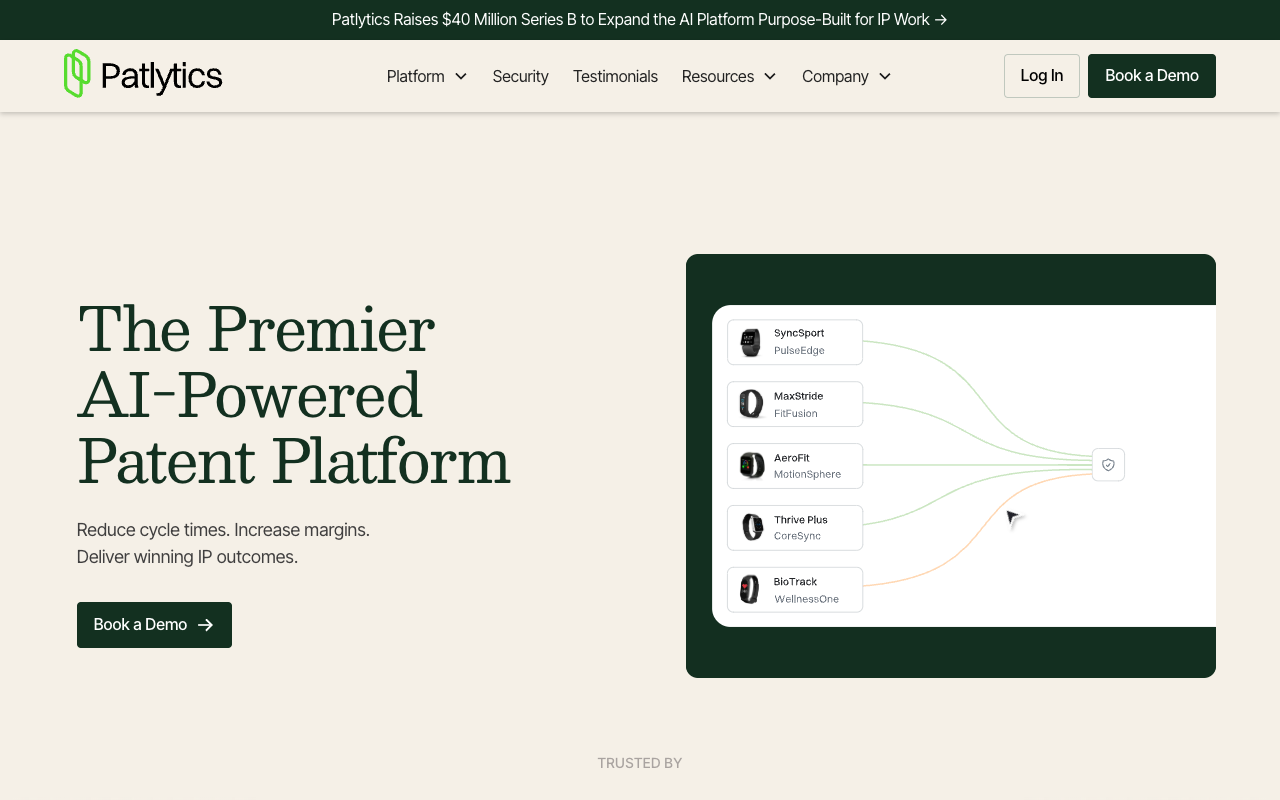
Patlytics is an AI patent intelligence platform whose center of gravity is analytics such as invalidity, infringement detection, and landscaping, and it also supports drafting. It raised a 40 million dollar Series B and lists customers including Canon, Sanofi, and Quinn Emanuel.
For explainability, Patlytics emphasizes audit-ready outputs and building a claim tree from your own source materials, auditing external and internal inputs including figures and slides. Its security posture is among the strongest in this list, with stated SOC 2 Type 2, ISO 27001, and ISO 42001 certifications and no model training on customer data.
The caveat is focus. Patlytics leads with analysis, so its transparency is oriented toward analytical outputs rather than a drafting redline trail.
Pros:
- Audit-ready outputs across analysis
- Builds a claim tree from your source materials
- Strong prior-art and invalidity grounding
- Top-tier stated security (SOC 2 Type 2, ISO 27001, ISO 42001)
Cons:
- Centered on analytics rather than drafting
- Explainability is analysis-oriented, not a drafting redline trail
Best For: Analytics-led teams that want audit-ready drafting alongside invalidity and infringement work.
5. Qthena: Best for human-in-control workflows backed by Questel data
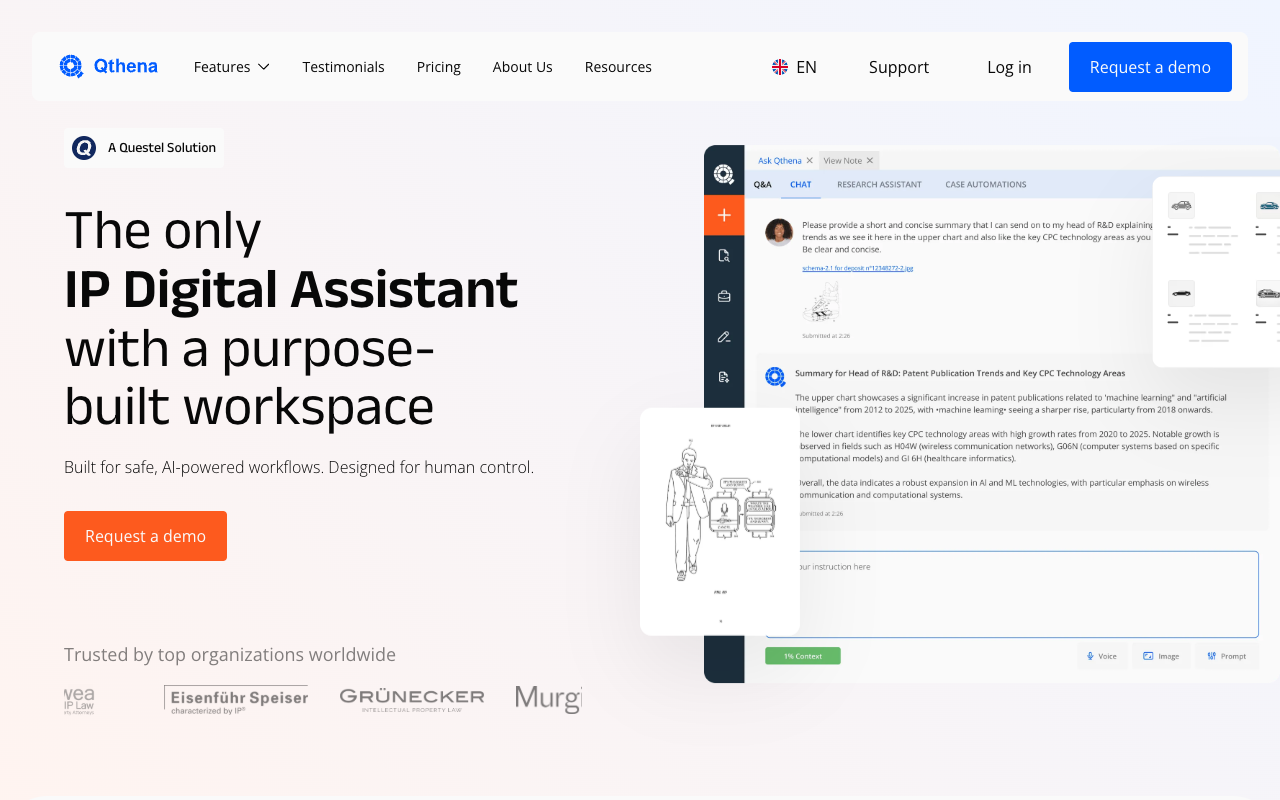
Qthena is an AI assistant for patent and trademark work, developed by ipQuants and powered by Questel, and it is positioned as an IP digital assistant built for safe, AI-powered workflows and designed for human control.
Its explainability comes from that posture. The Ask Qthena generative layer works over Questel's established patent data inside a purpose-built workspace, so suggestions draw on a known data source and a human reviews and controls outputs rather than accepting free generation.
Pros:
- Explicit human-in-control design
- Grounded in Questel's established patent data
- Full IP lifecycle in one workspace
- ISO 27001 and SOC 2 certified infrastructure, GDPR compliant
Cons:
- Explainability is workspace and data-provenance oriented rather than claim-level redlines
- Drafting is one module inside a broad IP suite
Best For: Teams that want human-in-control AI grounded in Questel's patent data.
6. Ankar AI: Best for evidence-backed reasoning across the lifecycle
Ankar AI positions itself as an operating system for the patent practice, spanning idea generation, drafting, prosecution, and infringement protection. It reports use by more than 1,000 IP professionals at Fortune 500 and AmLaw 100 organizations.
On explainability, Ankar describes evidence-backed reasoning across its workflows, so the reasoning behind a suggestion is surfaced at each connected stage rather than isolated to one screen. That breadth suits teams that want a single platform across the lifecycle.
Ankar does not state a dedicated claim-to-disclosure mapping feature, and its reasoning is described at a workflow level rather than as a per-claim redline, so drafting-first teams should confirm how granular the trail is in a demo.
Pros:
- Evidence-backed reasoning surfaced across connected stages
- Full-lifecycle coverage from idea generation to protection
- Strong enterprise adoption (Fortune 500 and AmLaw 100)
- Single connected platform rather than point tools
Cons:
- No stated dedicated claim-to-disclosure mapping
- Reasoning is described at a workflow level, not a per-claim redline
Best For: Teams that want reasoning surfaced across a connected, full-lifecycle platform.
7. PatentPal: Best for predictable, claim-driven specification and figures
PatentPal takes a different route to trust. Rather than generating claims, it expands the claims you already have into specification text and figures, which limits how much new substance the tool invents. You drop in a document with your claims, and it generates the spec and figures with one click, exporting to Word and Visio or PowerPoint.
Its explainability comes from being claim-driven and deterministic. Because the specification and figures follow directly from your claim set, an attorney can trace each generated passage back to the claim it supports. It generates flowcharts for methods, block diagrams for systems, and detailed descriptions of each figure, and it lets you customize generated phrasing through reusable profiles.
The trade-off is scope. PatentPal focuses on the mechanical writing of the specification and figures rather than claim strategy, prior-art analysis, or prosecution, so it works best as a fast drafting accelerator inside a broader workflow.
Pros:
- Expands your own claims, which limits invented substance
- Generates flowcharts, block diagrams, and figure descriptions
- Exports to Word and Visio or PowerPoint
- Customizable phrasing through reusable profiles
Cons:
- Focused on mechanical spec and figures rather than claim strategy or prosecution
- Explainability comes from being claim-driven rather than from an audit trail
- Less suited to end-to-end drafting
Best For: Teams that want fast, predictable specification and figure drafting derived directly from their own claims.
Comparison table
| Tool | Approach | Explainability signal | Security or traction | Best for |
|---|---|---|---|---|
| Esgenix | Multi-LLM agentic council | Redline audit trail, provenance, invention-claim mapping | Cloud-first, AES-256 at rest, customer-controlled option | Reviewable, examiner-ready drafting |
| Solve Intelligence | Interactive drafting platform | Claim-chart citations and expandable reasoning | 700+ IP teams; YC and Microsoft backed | Visible reasoning during drafting |
| DeepIP | Word-native platform | Word Track Changes log with rationale | ISO 27001, SOC 2 Type II, GDPR | Word-based teams |
| Patlytics | Analytics-led platform | Audit-ready outputs, claim tree from source | SOC 2 Type 2, ISO 27001, ISO 42001 | Analytics-led teams |
| Qthena | Questel IP assistant | Human-in-control, Questel-data grounded | ISO 27001, SOC 2; GDPR | Data-grounded workspace |
| Ankar AI | Full-lifecycle operating system | Evidence-backed reasoning across stages | 1,000+ IP pros; Fortune 500, AmLaw 100 | Full-lifecycle teams |
| PatentPal | Claim-driven spec and figures | Deterministic expansion of your claims | Word, Visio, and PowerPoint exports | Fast spec and figure drafting |
Product information checked on 28 August 2026.
How to choose the right explainable AI patent drafting tool
Picking the right tool depends on where your review time goes and how your team already works. Here is how to narrow it down.
Start from your review bottleneck. If partners spend the most effort verifying claim scope and written-description support, prioritize a tool with invention-claim mapping and a whole-draft audit trail, such as Esgenix. If the bottleneck is prosecution, a tool with strong claim-chart citations like Solve Intelligence may matter more.
Check how the tool grounds its output. The most hallucination-resistant tools tie output to your invention disclosure and to cited prior art. Look for data-grounded suggestions, as in Qthena, or claim-to-disclosure mapping, as in Esgenix, rather than free generation.
Match it to your existing workflow. Teams that live in Microsoft Word gain the most from DeepIP's native Track Changes log, while teams that want a dedicated platform may prefer a browser-based or council-based workflow.
Weigh confidentiality and security. Compare stated certifications and data-handling postures. DeepIP, Patlytics, and Qthena publish specific certifications, while Esgenix pairs a cloud-first default with a customer-controlled storage option for sensitive matters.
Remember the attorney stays responsible. Explainability does not remove review. Under ABA Formal Opinion 512 and USPTO guidance, the attorney verifies and files the work; a good tool makes that review faster and more defensible.
See how the council drafts
To see how an explainable, examiner-ready draft is produced with a full redline audit trail and invention-claim mapping, request a demo of Esgenix.
Frequently Asked Questions
What makes an AI patent drafting tool explainable?
It lets an attorney see where claim language came from, why it changed, and whether it maps back to the invention disclosure, usually through citations to source, a visible redline trail, and claim-to-disclosure mapping.
Which tool offers the most reviewable drafting?
Esgenix centers the whole product on explainability, with a redline audit trail, provenance to source, and invention-claim mapping. Solve Intelligence and DeepIP also provide strong transparency, inside claim charts and Word Track Changes respectively.
Does explainability remove the need for attorney review?
No. Under ABA Formal Opinion 512 and USPTO guidance, the attorney remains responsible for reviewing and filing AI-assisted work. Explainability makes that review faster and more defensible, not optional.
How is explainability different from accuracy?
Accuracy is whether the output is correct; explainability is whether you can see how it was produced. A tool can be explainable and still need correction, which is why the visible trail matters for catching errors before filing.
Why does explainability matter for 35 U.S.C. 112?
Antecedent basis and written-description support are frequent grounds for rejection. A tool that maps claims to the disclosure and shows its edits helps an attorney catch these issues before filing, measured against the standard in USPTO MPEP 2163.
Do these tools publish pricing?
No. The tools in this guide are demo or trial gated, so pricing is shared through a sales conversation rather than listed publicly.
More on tool evaluations: See how Esgenix drafts
See it on your own use case
Related articles

7 Best AI Tools for Drafting Patent Claims in 2026
Seven AI tools for drafting patent claims compared on scope control, disclosure grounding, and antecedent and clarity checks under 35 U.S.C. 112.
Esgenix Team · Sep 4, 2026 · 7 min read

7 Best AI Patent Tools for In-House and Corporate IP Teams in 2026
Seven AI patent tools for in-house and corporate IP teams compared on security certifications, lifecycle coverage, and governance fit.
Esgenix Team · Sep 4, 2026 · 7 min read

How to Benchmark AI Patent Draft Quality
Seven measures worth recording when you benchmark AI patent draft quality, the sample set to use, and the mistakes that invalidate the test.
Esgenix Team · Aug 17, 2026 · 8 min read