7 Best AI Patent Tools for In-House and Corporate IP Teams in 2026
Esgenix Team · Published September 4, 2026

On this page
- What corporate IP teams need from AI patent tools
- 1. DeepIP: Best for enterprise Word-native standardization
- 2. Patlytics: Best for corporate IP analytics and diligence
- 3. Esgenix: Best for explainable drafting with a defensible trail
- 4. Ankar AI: Best for a connected innovation-to-IP operating system
- 5. Qthena: Best for corporate IP teams that want a Questel-backed workspace
- 6. Solve Intelligence: Best for corporate prosecution and drafting consistency
- 7. PatentPal: Best for high-volume specification and figure output
- Comparison table
- How to choose a corporate AI patent tool
- See how the council drafts
- Frequently Asked Questions
In-house and corporate IP teams buy AI patent tools differently from outside firms. The priorities are volume, portfolio consistency, security that satisfies corporate governance, and integration with how R&D and legal already work. A tool that produces a nice single draft is not enough; it has to hold up across a large filing program and survive a security review.
The standout options include DeepIP for teams standardizing on Microsoft Word with enterprise security, Patlytics for corporate IP analytics, and Esgenix for explainable drafting with a defensible audit trail. This guide breaks down seven AI patent tools for in-house and corporate IP teams in 2026, comparing security, lifecycle coverage, and governance fit. None publish pricing; all are demo or trial gated.
What corporate IP teams need from AI patent tools
A corporate patent function protects a product portfolio, not a single invention, so the tooling question is about scale and control. Three needs dominate. First, security and data governance that a corporate information-security team will approve, including recognized certifications and clear data-handling terms. Second, consistency across drafters and outside counsel, so the portfolio reads coherently. Third, coverage beyond drafting, since corporate teams also run freedom-to-operate, invalidity, and landscape analysis around their products.
Explainability matters here for a governance reason. When AI assists a filing, the department needs a record of what the tool did, both to review internally and to demonstrate diligence. Under ABA Formal Opinion 512 and USPTO guidance, the practitioner remains responsible, so an auditable trail supports both review and defensibility.
1. DeepIP: Best for enterprise Word-native standardization
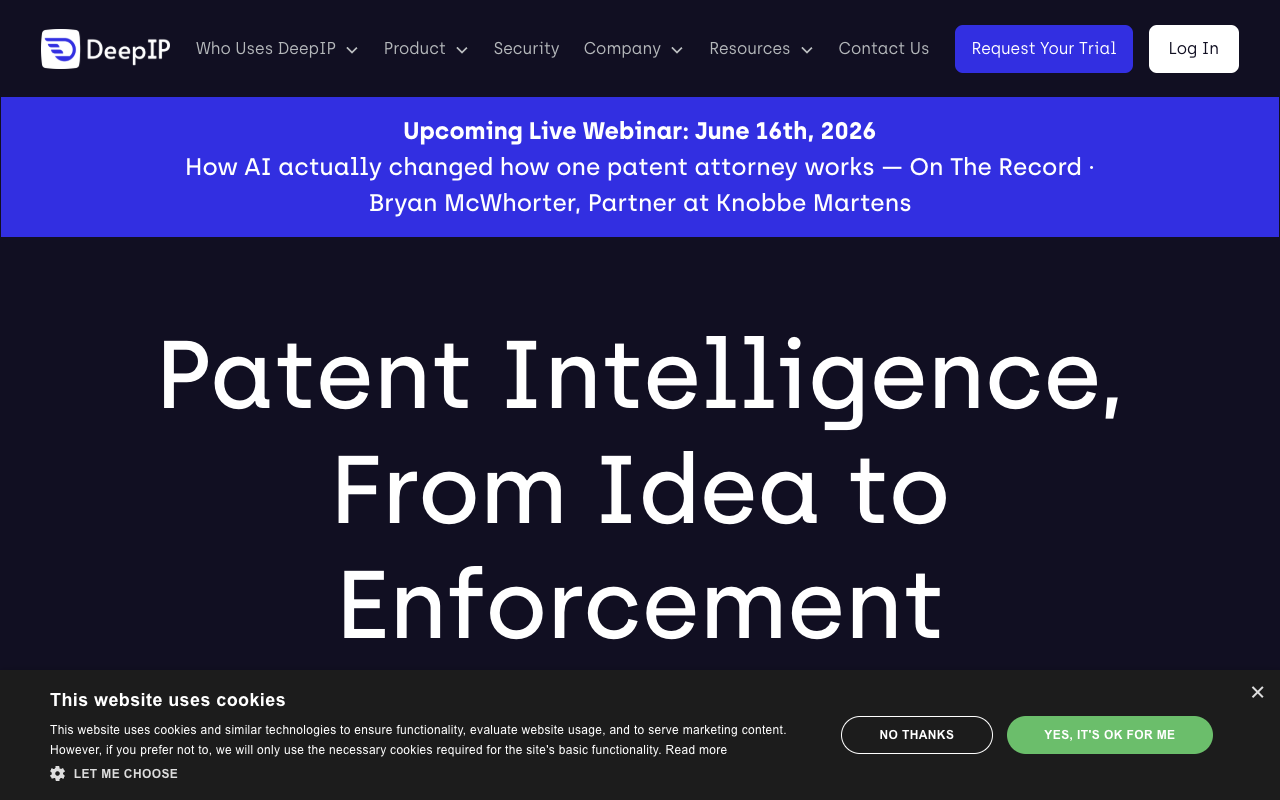
DeepIP works inside Microsoft Word, which is often the path of least resistance for a corporate team and its outside counsel. It covers invention capture, drafting, prosecution, drawings, FTO, invalidity, and portfolio intelligence, so a department can standardize on one platform across the lifecycle.
Its security posture is built for corporate review: stated ISO 27001, SOC 2 Type II, GDPR, zero data retention, no training on customer data, and Azure hosting. The AI Reviewer logs every change with author, timestamp, and rationale, which gives the department an audit trail by default.
Pros:
- Native Microsoft Word workflow across the lifecycle
- Strong, review-ready security certifications
- Change log with author, timestamp, and rationale
- Broad coverage from drafting to portfolio work
Cons:
- Value is highest for Word-standardized teams
- Breadth may exceed a small in-house group's needs
- Pricing is not published
Best For: Corporate teams that want one Word-native platform with enterprise-grade security.
2. Patlytics: Best for corporate IP analytics and diligence
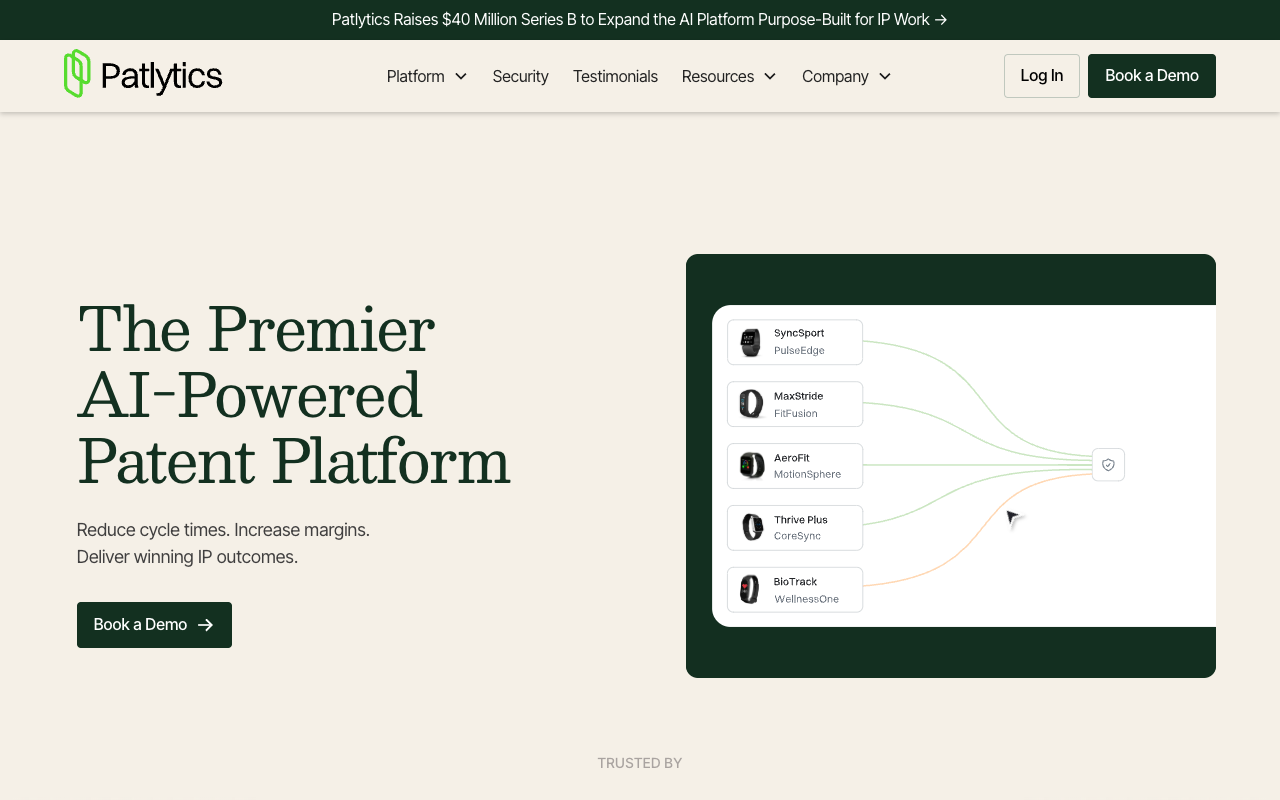
Patlytics leads with the analytics a corporate team runs around its products: invalidity, infringement detection, and landscaping, with drafting alongside. For a department that spends as much time on freedom-to-operate and competitor monitoring as on filing, that analytical core is the draw.
Its security posture is among the strongest here, with stated SOC 2 Type 2, ISO 27001, and ISO 42001 certifications and no model training on customer data. It is well funded, with a 40 million dollar Series B and customers including Canon and Sanofi.
Pros:
- Deep invalidity, infringement, and landscaping analytics
- Audit-ready outputs and claim trees for drafting
- Top-tier stated security certifications
- Strong enterprise customer base
Cons:
- Drafting is secondary to analytics
- Best value for analytics-heavy teams
- Pricing is not published
Best For: Corporate teams whose work spans diligence, FTO, and analytics as much as drafting.
3. Esgenix: Best for explainable drafting with a defensible trail
Esgenix gives a corporate team an auditable drafting record. Its multi-LLM council drafts and debates claim language, attaches provenance to source, maps claims back to the invention disclosure, and runs an Examiner's Lens for USPTO and EPO checks. For a department that must show diligence on AI-assisted filings, that trail is the point.
On data governance, it is secure cloud-first by default with AES-256 encryption at rest and encrypted transport, plus a customer-controlled storage option for sensitive matters, which helps when specific programs need tighter control.
Pros:
- Redline audit trail supports internal review and diligence
- Invention-claim mapping across the portfolio
- Examiner's Lens checks issues before filing
- Customer-controlled storage option for sensitive programs
Cons:
- Newer entrant with a shorter enterprise track record
- Pricing is demo-gated and not published
- Focused on drafting rather than broad analytics
Best For: Corporate teams that need defensible, explainable drafting they can review and stand behind.
4. Ankar AI: Best for a connected innovation-to-IP operating system
Ankar AI spans idea generation, drafting, prosecution, and infringement protection, which fits corporate teams that want R&D and IP on one connected surface. It reports adoption by more than 1,000 IP professionals at Fortune 500 and AmLaw 100 organizations, and it publishes efficiency figures on ankar.ai.
For a department trying to reduce friction between inventors, attorneys, and management, a single lifecycle platform can matter more than the deepest option on any one step.
Pros:
- Connected lifecycle from ideation to protection
- Strong Fortune 500 and AmLaw 100 adoption
- Evidence-backed reasoning across modules
- Reduces handoff friction across functions
Cons:
- No stated dedicated claim-to-disclosure mapping
- Efficiency figures are vendor-reported
- Pricing is not published
Best For: Corporate teams that want one connected platform across innovation and IP.
5. Qthena: Best for corporate IP teams that want a Questel-backed workspace
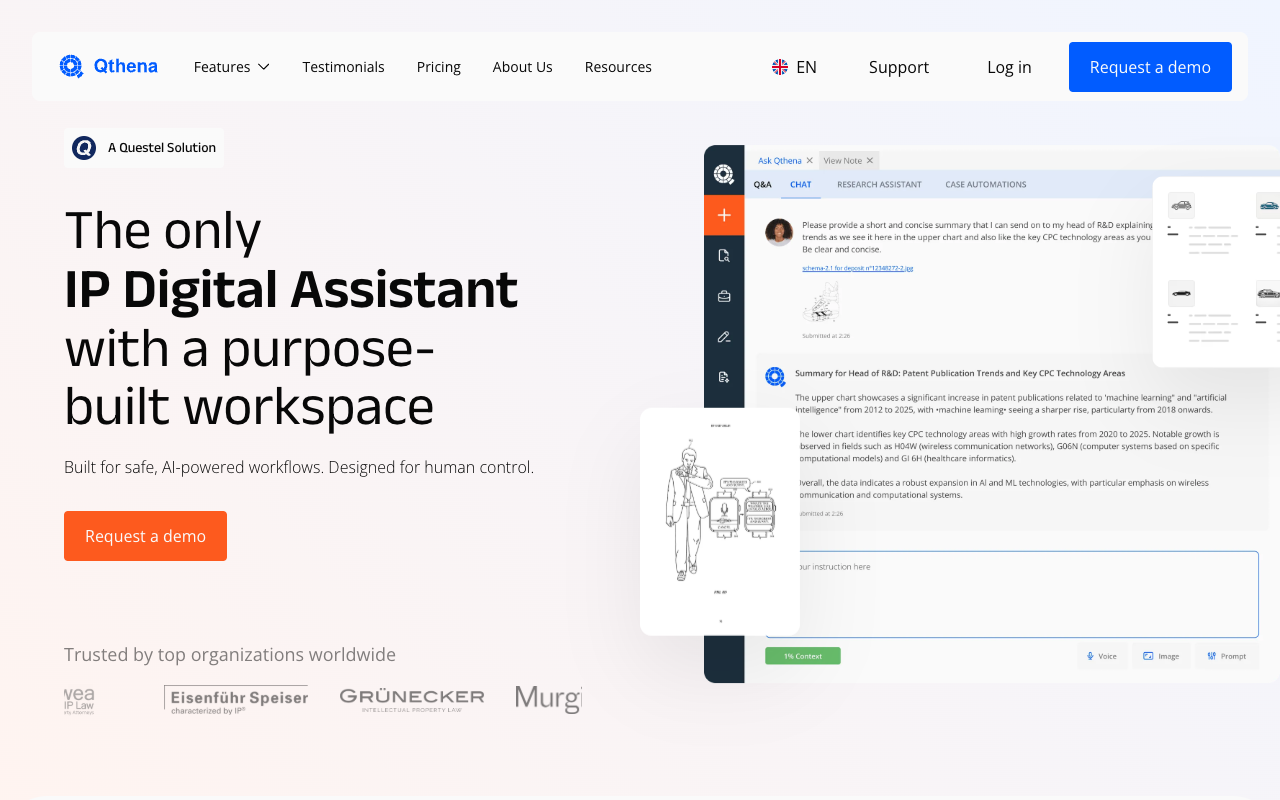
Qthena is an AI assistant for patent and trademark work, developed by ipQuants and powered by Questel. It brings invention disclosure generation, patent search review, freedom-to-operate analysis, drafting, and claim chart generation into one collaborative workspace.
For a corporate department that manages search, FTO, and portfolio work alongside drafting, Qthena's breadth on top of Questel's patent data can consolidate several tasks in one place, with an Ask Qthena layer designed to keep a human in control.
Pros:
- Backed by Questel's established patent and trademark data
- Consolidates search, FTO, drafting, and claim charts in one workspace
- Ask Qthena generative AI designed for human control
- ISO 27001 and SOC 2 certified infrastructure, GDPR compliant
Cons:
- Drafting is one module inside a broad IP suite
- Breadth-first workspace rather than a drafting specialist
- Pricing is not published
Best For: Corporate IP teams that want drafting inside a Questel-backed workspace.
6. Solve Intelligence: Best for corporate prosecution and drafting consistency
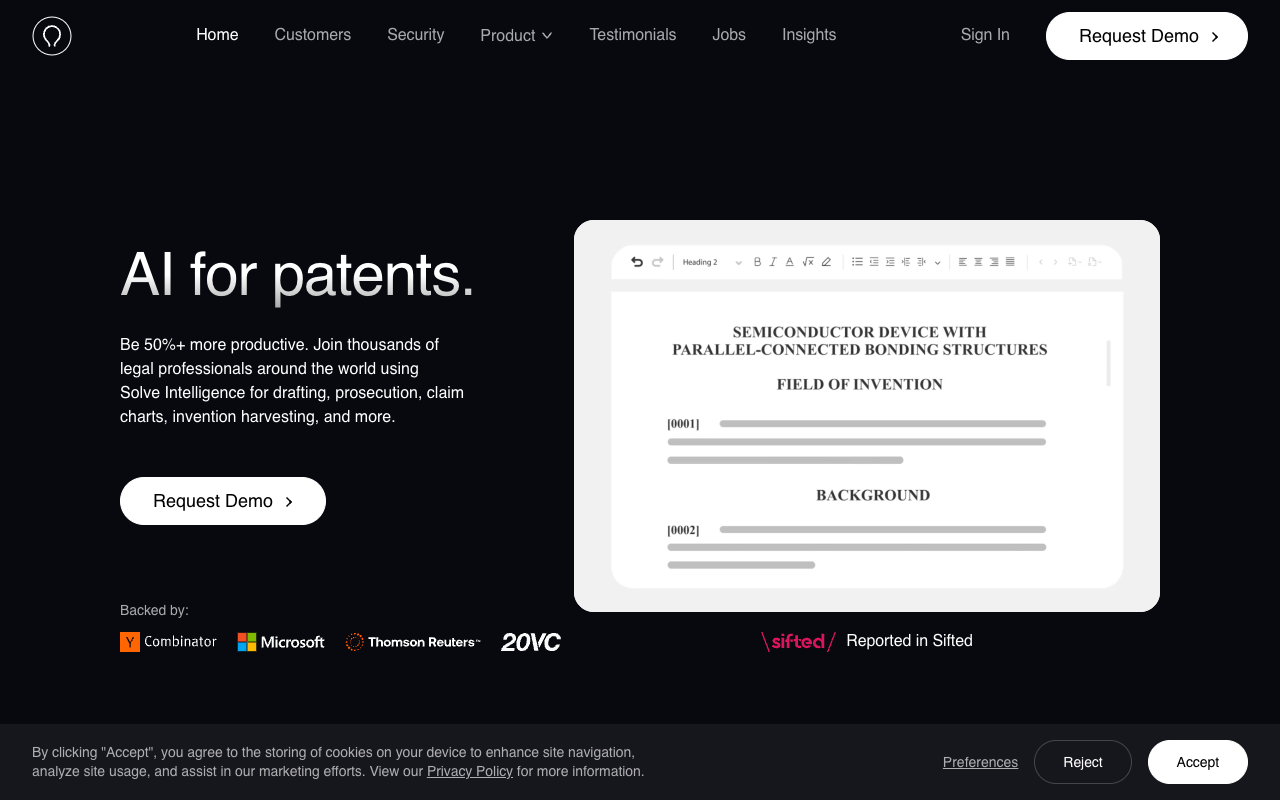
Solve Intelligence brings interactive drafting that adapts to a drafting style, which helps a corporate team keep filings consistent across drafters and outside counsel. Its prosecution support, with office action responses citing the file wrapper and case law, extends that consistency into responses.
Used by more than 700 IP teams and backed by Y Combinator, Microsoft's M12, and Thomson Reuters Ventures, it is a mature option for departments that want a proven drafting tool.
Pros:
- Style-consistent drafting across a team
- Strong prosecution support with citations
- Broad, proven adoption
- Handles complex figures and sequences
Cons:
- Public material does not describe a multi-model cross-check
- Transparency centered in claim charts
- Pricing is not published
Best For: Corporate prosecution teams that want consistent, citable drafting.
7. PatentPal: Best for high-volume specification and figure output
PatentPal helps a corporate team cut the mechanical time in every application by expanding claims into specification text and figures, exporting to Word and Visio or PowerPoint. For a high-volume filing program, that predictable output reduces the hours spent on boilerplate spec and drawings.
It focuses on the mechanical parts of an application rather than claim strategy or prosecution, so it works best as an accelerator inside a broader corporate workflow.
Pros:
- Fast, predictable spec and figure generation
- Expands your own claims, limiting invented substance
- Exports to Word and Visio or PowerPoint
- Free trial available
Cons:
- Focused on spec and figures, not strategy or prosecution
- No prior-art analysis
- Best used alongside other tools
Best For: High-volume corporate programs that want to cut mechanical drafting time.
Comparison table
| Tool | Corporate strength | Security | Lifecycle coverage | Best for |
|---|---|---|---|---|
| DeepIP | Word-native standardization | ISO 27001, SOC 2 Type II, GDPR | Broad | Enterprise Word teams |
| Patlytics | Analytics and diligence | SOC 2 Type 2, ISO 27001, ISO 42001 | Analytics-led | Diligence-heavy teams |
| Esgenix | Explainable, defensible drafting | Cloud-first, AES-256, customer-controlled option | Drafting and prosecution | Defensible drafting |
| Ankar AI | Connected innovation-to-IP | Enterprise platform | Full lifecycle | Connected teams |
| Qthena | Full-lifecycle IP workspace | ISO 27001, SOC 2; GDPR | Questel-backed | Corporate IP teams |
| Solve Intelligence | Drafting consistency | Enterprise drafting platform | Drafting and prosecution | Prosecution teams |
| PatentPal | High-volume spec output | Trial available | Spec and figures | High-volume programs |
How to choose a corporate AI patent tool
Lead with your security review. Shortlist only tools whose certifications and data-handling terms will pass your information-security team. DeepIP, Patlytics, and Qthena publish specific certifications; Esgenix pairs a cloud-first default with a customer-controlled option.
Map the tool to your real workload. If diligence and FTO dominate, weight analytics platforms. If filing volume dominates, weight drafting depth and spec automation.
Standardize on your existing stack. Teams committed to Microsoft Word gain the most from DeepIP; teams building a dedicated platform may prefer a council-based or suite approach.
Demand an audit trail. For governance, favor tools that record what the AI did, such as Esgenix's redline trail or DeepIP's Track Changes log.
Pilot at portfolio scale. Run a representative batch of disclosures, not one showcase invention, and measure consistency, review effort, and security fit before committing.
See how the council drafts
To see how explainable, examiner-ready drafting produces a defensible audit trail across a portfolio, request a demo of Esgenix.
Frequently Asked Questions
What matters most when a corporate IP team picks an AI tool?
Security and data governance usually come first, followed by lifecycle coverage and consistency across drafters. The tool has to pass an information-security review and hold up across a filing program, not just produce one good draft.
Which tools have the strongest security certifications?
DeepIP states ISO 27001, SOC 2 Type II, and GDPR; Patlytics states SOC 2 Type 2, ISO 27001, and ISO 42001; Qthena states ISO 27001 and SOC 2, and GDPR compliance. Esgenix is cloud-first with AES-256 and a customer-controlled storage option. Confirm current details with each vendor.
Do these tools integrate with corporate workflows?
DeepIP works inside Microsoft Word, while Ankar and Qthena offer broad platforms spanning IP data, search, and drafting. The right fit depends on your existing systems and how much lifecycle coverage you need.
Do these tools publish pricing?
No. The tools in this guide are demo or trial gated, so pricing is provided through a sales conversation.
How should a corporate team run a pilot?
Use a representative batch of disclosures rather than one invention, and measure security fit, consistency across drafters, review effort, and how well the tool documents what it did.
More on tool evaluations: See how Esgenix drafts
See it on your own use case
Related articles

How to Benchmark AI Patent Draft Quality
Seven measures worth recording when you benchmark AI patent draft quality, the sample set to use, and the mistakes that invalidate the test.
Esgenix Team · Aug 17, 2026 · 8 min read

AI Patent Drafting Tools in India: Why the Priority Document Decides Everything
Why the Indian priority document decides your US and EP outcomes, and what that means when evaluating AI patent drafting tools in India.
Esgenix Team · Aug 17, 2026 · 8 min read

AI Patent Drafting Tools That Don't Hallucinate: What to Test Before You Buy
How to test an AI patent drafting tool for grounding before you buy: provenance per claim element, gap detection, and a held-back reference.
Esgenix Team · Aug 17, 2026 · 9 min read