Patlytics, Solve Intelligence, Esgenix: Draft Evidence 2026
Esgenix Team · Published October 29, 2026

On this page
- Patlytics vs Solve Intelligence vs Esgenix Categories
- What does “how each produces and evidences a draft” mean?
- How we evaluated these platforms
- Research & Evidence
- Three Draft-Evidence Approaches Compared
- Comparison Table
- How to Choose Between Patlytics, Solve Intelligence, and Esgenix
- Getting Started With a Real-Matter Evaluation
- Frequently Asked Questions
Patlytics, Solve Intelligence, Esgenix: Draft Evidence 2026
Patlytics, Solve Intelligence, and Esgenix all help patent professionals turn technical materials into reviewable patent work. The useful comparison is not simply who generates more text. It is how each platform produces a draft, connects it to supporting material, and asks a patent professional to review it. Choose Patlytics if you want drafting connected to a wider set of patent-analysis workflows. Choose Solve Intelligence if multimodal drafting, figures, chemical structures, and inline review are central to your matters. Choose Esgenix if your team wants production work organized between five counsel decisions, with claim support, search findings, scope options, and independent review inside one matter workflow.
This article is based on desk research of published vendor materials, not hands-on testing or customer interviews. Patlytics describes audit-ready disclosures and citation-backed drafting outputs in its Patent Application Drafting page. Solve Intelligence describes a drafting workflow that produces text, figures, chemical structures, and sequence listings in its Patent Application Drafting page. Esgenix describes claim-level disclosure support and draft review in its patent-drafting materials.
Patlytics vs Solve Intelligence vs Esgenix Categories
These three products overlap in patent drafting, but their public materials frame the work differently.
- Connected patent-work environments: Patlytics positions drafting as one stage connected to research, prosecution support, claim analysis, and other patent work. Its evidence emphasis is source auditing, citations, confidence signals, and practitioner review.
- Multimodal drafting and inline review: Solve Intelligence centers on producing application text and supporting technical artifacts in the same platform, then reviewing the result against configurable criteria.
- Decision-gated patent production: Esgenix is a patent production system and a decision-gated agentic patent workflow platform. It organizes machine production between five named counsel gates: Intake, Strategy, Claims, Specification & Figures, and Sign-off.
That distinction matters because a generated draft is not the final work product. Your team still needs a practical way to check support, settle claim breadth, assess drafting issues, and decide whether the matter should advance.
What does “how each produces and evidences a draft” mean?
A patent draft has two separate questions behind it. First, how was the draft produced? A system may start with an invention disclosure, templates, prior-art results, technical figures, or a combination of these inputs. It may generate a full application at once or guide the professional through edits and review comments.
Second, how can the professional test the draft? Evidence can mean citations to source material, a link between a claim limitation and disclosure text, an explanation for a review comment, or prior-art findings that influenced claim direction. Each approach helps with a different kind of review.
For example, an inline comment may identify an antecedent-basis issue or an unsupported phrase. That is useful during drafting review. A claim-to-disclosure link answers a different question: where did this limitation come from, and does the invention material support it? Prior-art context adds another layer: should the claim be broadened, narrowed, or supported by a fallback position before the draft progresses?
This is why feature checklists can mislead. Several platforms may generate claims, specifications, or figures. The real evaluation asks how your team works through a live matter after the first output appears. Who decides claim scope? Can the team inspect supporting material? Does review occur only at the end, or while strategy is still editable?
For Esgenix, that boundary is explicit. An agent is an AI component assigned a defined role and able to complete several steps toward an objective. Esgenix uses the Esgenix Council, a group of role-specialized agents using different underlying models and behaviors. The agent producing work is not the only agent judging it. Counsel approves the matter at the five gates.
How we evaluated these platforms
This comparison is not ordered by popularity, vendor claims, or paid placement. Patlytics, Solve Intelligence and Esgenix are assessed on the same four axes:
- How the draft is produced. Where the work starts, what the platform generates, and where the professional works.
- How the output is grounded. How claims and specification text are tied back to the invention disclosure and the cited art, and what a reviewer can trace.
- Data handling. Model training, retention, storage, and the options available for sensitive matters.
- Who it suits. The team, the tooling, and the matter type each route fits best.
Esgenix is one of the three assessed on those axes, on the same evidence basis as the other two.
The evidence base is verified public information only: vendor documentation, published product pages, and stated security posture at the time of writing. This is desk research, not hands-on testing or a performance benchmark. Where a capability could not be confirmed from a public source, it is described as unconfirmed rather than inferred.
One disclosure. This article is published by Esgenix, which builds one of the platforms described here. It is included for that reason, and every claim made about the others is checkable against the same public sources cited throughout.
Product information checked: September 2026.
Research & Evidence
The published materials support a useful evidence map. It is an original desk-research analysis of what each vendor publicly identifies as the reviewable unit of work, not a product-performance ranking.
| Platform | Publicly described drafting input | Publicly described evidence or review unit | What that means for review |
|---|---|---|---|
| Patlytics | Structured invention disclosures and configurable templates | Source auditing, confidence indicators, citations, and attorney approval | Teams can inspect source-linked output while keeping the work connected to other patent tasks. |
| Solve Intelligence | Invention disclosures and technical source material | Inline comments, reasoning, clickable citations, and configurable checks | Review is oriented around identified issues in claims and specifications. |
| Esgenix | Structured invention context, prior-art findings, and approved claim strategy | Claim Provenance, search-informed strategy, Examiner's Lens, and Adversarial Review | Counsel can review support, scope, and quality issues at defined decision points. |
Patlytics publicly describes a connected workflow spanning drafting and other patent-analysis activities in its Patlytics vs. Solve Intelligence article. Solve Intelligence states that its Review capability runs more than 50 application checks, including antecedent basis, specification support, invention-disclosure coverage, and template compliance. Esgenix describes Prior Art Radar as prior-art intelligence that can inform claim strategy and drafting within the same matter workflow.
Public claims do not replace an evaluation on a representative matter. They do, however, tell you where to focus a demo: draft input, evidence links, reviewer workflow, and the point at which professional approval is required.
Three Draft-Evidence Approaches Compared
The order below follows the requested comparison order. It is not a score or a claim that one platform fits every patent team.
1. Patlytics: Best for connected drafting and patent analysis
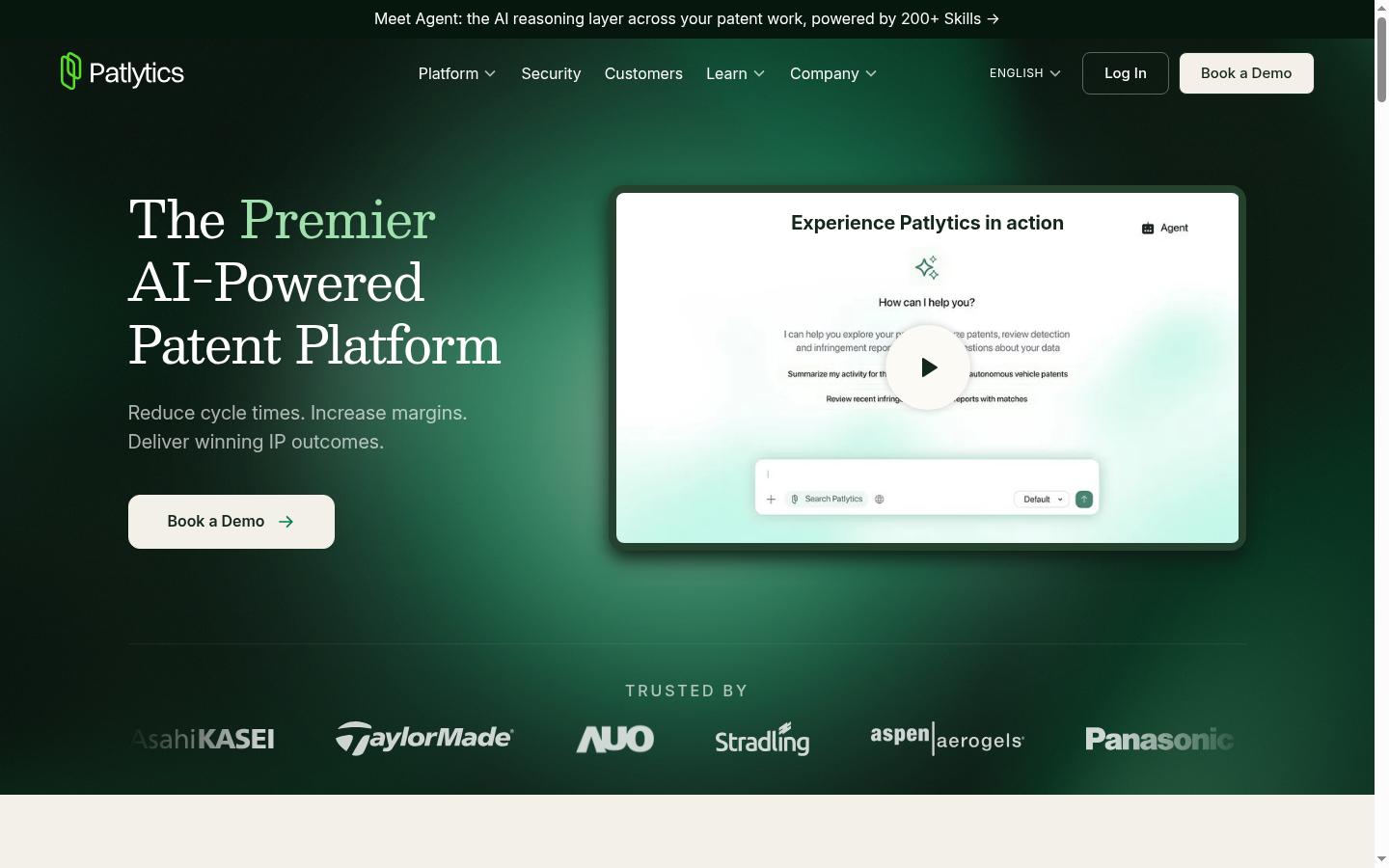
Patlytics positions drafting as part of a connected patent-work environment rather than an isolated document exercise. Its public materials describe taking materials such as documents, presentations, images, technical figures, and spoken inputs into an audit-ready invention disclosure, then generating a draft using configurable templates.
The central idea is continuity across patent work. Patlytics says its drafting workflow can connect source materials, claim structures, prior-art findings, and citation-backed evidence to related analysis and review workflows. That may suit teams that want drafting to remain closely tied to other work performed on the same asset.
Key features:
- Audit-ready invention disclosure forms based on varied technical inputs
- Configurable drafting templates for jurisdictions, technologies, and practitioner preferences
- Source auditing, confidence indicators, and citation-backed output
- Attorney review and approval of generated work
Pricing: Custom enterprise pricing. Patlytics does not publish INR pricing in the supplied materials.
Best for: Law firms and corporate IP teams that want drafting connected to broader research, claim-analysis, and patent-work processes.
Pros:
- Keeps drafting connected to source materials and related analysis.
- Public materials emphasize citations and auditability for practitioner review.
- Supports configurable templates and review of suggested edits.
Cons:
- Public pricing is quote-based, with no INR pricing supplied.
- Patlytics states that generated analysis and cited evidence still require practitioner review, so it should not be treated as a substitute for legal determination.
Patlytics' Patent Application Drafting page is the relevant source for its disclosure, drafting, evidence, and review claims.
2. Solve Intelligence: Best for multimodal application drafting
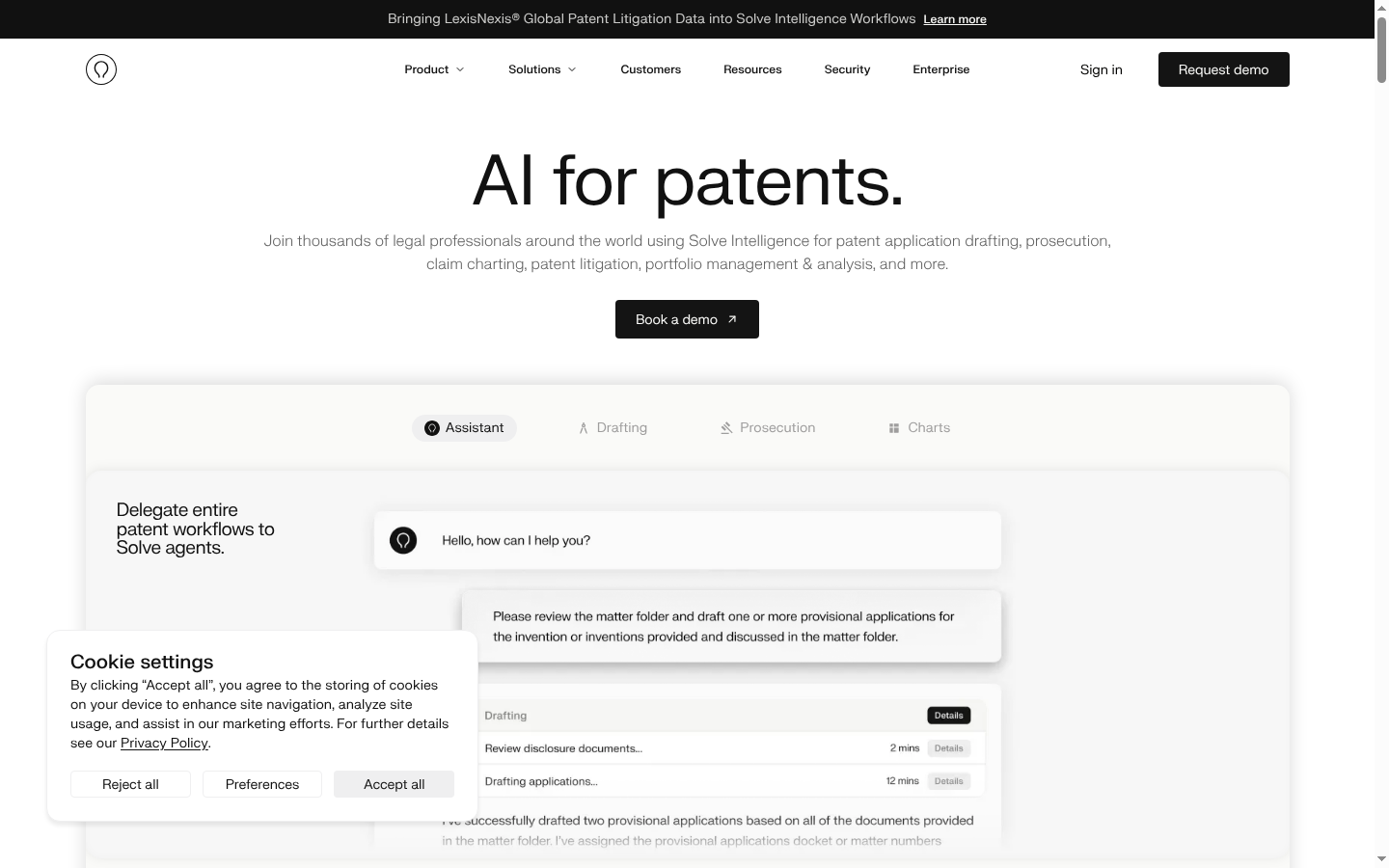
Solve Intelligence is a strong fit when the application work includes more than prose. Its public materials describe generating patent text, drawings, chemical structures, and biological sequence listings within the same drafting platform. That makes it especially relevant for life-sciences, chemistry, software, mechanical, and electronics matters where technical artifacts are part of the work product.
Its evidence model centers on review comments. Solve Intelligence states that its Review capability gives inline issue comments with reasoning and clickable citations, while configurable templates can apply jurisdiction-aware and firm-specific criteria. The practical question for a buyer is whether issue-based review matches the way your team currently checks application quality.
Key features:
- Patent text, figures, chemical structures, and sequence listings
- Drawing generation and editing, including reference-numeral labeling
- Microsoft Word-compatible templates and collaboration
- Configurable review criteria and inline review comments
Pricing: Solve Intelligence publicly lists plans in USD, but no INR-denominated public pricing was identified in the supplied materials.
Best for: Patent professionals handling technically complex applications that require text, figures, structures, or sequence listings in the same workflow.
Pros:
- Publicly described multimodal workflow supports several technical artifact types.
- Inline review comments include stated reasoning and citations.
- Review templates can be configured for client requirements and house style.
Cons:
- Public pricing is not stated in INR.
- The supplied public materials support a review-oriented workflow, but a buyer should test how its review comments fit the firm's own sign-off process.
Solve Intelligence describes these capabilities in its Patent Application Drafting page.
3. Esgenix: Best for decision-gated patent production
Esgenix is built around a different operating model: the unit of automation is the workflow between decisions. Counsel directs the matter at five gates, while the Esgenix Council performs production work between them. The gates are Intake, Strategy, Claims, Specification & Figures, and Sign-off.
At Intake, counsel confirms invention understanding, resolves technical gaps, and chooses jurisdictions. At Strategy, counsel sets claim direction, breadth, and fallback positions. Counsel then approves or modifies claims, reviews the specification and figures, and completes Sign-off. This structure makes the professional approval point explicit whenever machine execution advances the matter.
Key features:
- Technical Gap Detection to surface missing technical information for professional review
- Prior Art Radar, which can carry prior-art findings into claim strategy and drafting
- Scope Slider, a counsel-controlled mechanism for exploring claim breadth and fallback positions
- Claim Provenance, which maps claim elements to supporting invention material
- Multi-LLM Claim Composer, Examiner's Lens, and Adversarial Review
- Automatic Patent Drawings planned from the specification, including matters without a CAD baseline where supported
Pricing: Matter-oriented commercial model. Public materials do not state INR pricing.
Best for: Patent attorneys, patent agents, law firms, and corporate IP teams that want a search-to-filing workflow for US, European, and Indian practice, with substantive decisions reserved for counsel.
Pros:
- Five explicit gates create a defined review structure rather than leaving approval points implicit.
- Prior-art findings can shape claim strategy while claims remain editable.
- Generation and judgment are separated: Adversarial Review attempts to find weaknesses before professional Sign-off.
Cons:
- Practice-native drafting is publicly stated for US, European, and Indian practice, not as equivalent native support for every jurisdiction.
- Esgenix is not designed to replace professional strategy, judgment, modification, or approval.
Esgenix describes claim support, Scope Slider, quality review, and specification-matched figures in its patent-drafting materials.
Comparison Table
| Product | Best for | How the draft is produced | Evidence and review emphasis | Professional decision model | Starting price |
|---|---|---|---|---|---|
| Patlytics | Connected drafting and patent analysis | Structured disclosure plus configurable drafting templates | Citation-backed output, source auditing, confidence indicators, and attorney approval | Practitioner reviews and approves generated analysis and work product | Custom quote, no public INR price identified |
| Solve Intelligence | Multimodal technical drafting | Disclosure-driven application drafting with figures, structures, and sequence listings | Inline comments, reasoning, clickable citations, and configurable checks | Patent professional reviews issues and applies judgment | Public USD plans, no public INR price identified |
| Esgenix | Decision-gated patent production | Role-specialized production across search, strategy support, claims, specification, figures, and review | Claim Provenance, search-to-claim context, Examiner's Lens, and Adversarial Review | Counsel directs at Intake, Strategy, Claims, Specification & Figures, and Sign-off | Matter-oriented quote, no public INR price identified |
Data, model training, and retention
The supplied Patlytics materials state that customer data is not used to train or tune models. The supplied research materials for Solve Intelligence do not provide equivalent model-training and retention wording for publication in this comparison. For Esgenix: Invention disclosures and drafting artifacts are not used to train models. Esgenix operates under zero-data-retention agreements with its model providers. Ask each vendor to provide current contractual and technical terms for model training, retention, access controls, encrypted transport, storage, and sensitive-matter options before procurement.
How to Choose Between Patlytics, Solve Intelligence, and Esgenix
Start with the review problem your team wants to solve. If drafting must stay connected to a broad range of patent-analysis work, Patlytics may be the most relevant first evaluation. If your matters frequently require figures, chemical structures, or sequence listings alongside the application text, Solve Intelligence deserves focused review.
Choose Esgenix when your bigger problem is production coordination between professional decisions. Its model suits teams that do not want to hand-carry context from disclosure to prior art, claim strategy, specification, and figures, but still want counsel to decide what the invention is, where protection should sit, what claims should cover, and whether the application is ready to progress.
During a vendor evaluation, ask five practical questions:
- Can we trace a claim limitation back to supporting invention material? Ask to inspect a real example, not just a summary screen.
- How do prior-art findings affect claim direction? Confirm whether search results remain linked to drafting decisions while claims are still editable.
- What does the reviewer see? Compare source citations, claim-support links, inline comments, and issue explanations.
- Who can approve advancement? Map each product's workflow to your firm's or team's actual professional sign-off points.
- What is not publicly stated? Ask directly about integrations, support levels, data retention, model training, deployment options, and current commercial terms.
Look, no public product page can answer every procurement question. A representative matter, clear acceptance criteria, and professional review are still the right test.
Getting Started With a Real-Matter Evaluation
Use a non-confidential or appropriately approved representative disclosure. Pick a matter with enough technical detail to test the issues your team actually faces, such as difficult claim scope, incomplete invention notes, known prior art, or a specification that needs figures.
Then define what a successful review looks like before the demo. You might require a trace from claim limitations to disclosure support, a visible response to relevant prior art, a review of terminology and antecedent basis, and figures whose reference numerals match the specification.
For an Esgenix evaluation, bring one invention disclosure and ask to see the five gates in action. At Strategy, inspect how Scope Slider presents breadth and fallback positions. At Claims and Specification & Figures, inspect Claim Provenance, Examiner's Lens, Adversarial Review, and the relationship between figures and text. Counsel remains responsible for each substantive decision.
If your team wants to assess that approach on a real matter, request a demo from Esgenix. Counsel directs. Esgenix delivers.
Frequently Asked Questions
What is the main difference between Patlytics, Solve Intelligence, and Esgenix?
Patlytics emphasizes connected patent-work workflows and citation-backed output. Solve Intelligence emphasizes multimodal drafting and inline review. Esgenix organizes patent production between five counsel decision gates with claim provenance and independent review.
Which platform is best for patent applications with chemical structures or sequence listings?
Solve Intelligence is the most directly relevant option in the supplied materials because it publicly describes generating patent text, figures, chemical structures, and biological sequence listings in one drafting workflow.
How does Esgenix show support for an AI-generated claim?
Esgenix uses Claim Provenance to map a claim element to supporting invention material. Counsel reviews the claim set at the Claims gate and reviews support again at the Specification & Figures gate.
Do Patlytics, Solve Intelligence, or Esgenix publish INR pricing?
No INR-denominated public pricing was identified in the supplied materials. Patlytics uses custom enterprise quotes, Solve Intelligence publicly lists USD plans, and Esgenix uses a matter-oriented commercial model.
Can prior-art findings influence drafting in Esgenix?
Yes. Esgenix states that Prior Art Radar can inform claim strategy and drafting within the same matter workflow, while counsel approves strategy and claim decisions at named gates.
Does patent AI replace patent attorney review?
No. Each vendor's public materials retains professional review. Esgenix explicitly reserves strategy, judgment, modification, and approval for counsel at its five decision gates.
See it on your own use case
Related articles

How AI Can Flag Examiner-Style Objections Before You File
See how Esgenix AI flags examiner-style objections before filing by surfacing claim support gaps and inconsistencies for review at the five decision gates. No predictions or guarantees. Request a demo.
Esgenix Team · Oct 29, 2026 · 9 min read

8 Solve Intelligence Alternatives for Patent Drafting 2026
Compare eight Solve Intelligence alternatives for patent drafting in 2026, including decision-gated workflows, Word tools, services, pricing visibility, and fit.
Esgenix Team · Oct 29, 2026 · 11 min read

8 Patlytics Alternatives for Patent Professionals in 2026
Compare eight Patlytics alternatives for patent work in 2026, from drafting and figures to search workflows, with fit, limitations, and pricing visibility.
Esgenix Team · Oct 29, 2026 · 11 min read