What a Patent Search Misses: Finding Non-Patent Literature Before You Draft
Esgenix Team · Published October 15, 2026

On this page
- Key Takeaways
- What Non-Patent Literature Actually Contains
- Where Non-Patent Literature Hides, by Field
- Why NPL Matters for Patentability and Claim Strategy
- Major NPL Source Types and Verification Requirements
- Common Gaps When NPL Is Treated as a Separate Report
- Integrating NPL Findings into Claim Strategy and Drafting
- Conclusion
- Frequently Asked Questions
What a Patent Search Misses: Finding Non-Patent Literature Before You Draft
Non-patent literature supplies earlier publication dates and enabling technical detail that patent databases alone cannot capture. A complete prior art search must locate and verify these sources while claims remain editable so that findings shape breadth, fallback positions, and specification support.
Consider how low the bar actually sits.
A researcher reads a paper aloud at a scientific meeting open to anyone interested in the subject. Written copies are available on request. Six people ask for one.
That was enough. In Massachusetts Institute of Technology v. AB Fortia, 774 F.2d 1104 (Fed. Cir. 1985), the court held that paper was a printed publication, and therefore prior art. No journal issue. No patent filing. Six copies handed out in a room.
A search confined to patent databases would never have found it.
This article covers what non-patent literature (NPL) contains, where it hides by technical field, how to verify each source type, and how to keep those findings usable while the claims can still change.
Key Takeaways
NPL is not an optional supplement to a patent-database search. It is part of the field of search that examiners already use, and its earlier effective dates often control novelty and inventive-step analysis before any patent document is published.
- NPL includes academic papers, preprints, theses, technical standards and drafts, conference proceedings, white papers, open-source repositories, product manuals, datasheets, and archived web content.
- A patent application is not published until 18 months after its earliest filing date under 35 U.S.C. 122(b)(1)(A), so a paper, standard, or repository disclosing the same subject matter is usually public long before any patent document covering it appears.
- A 2016 peer-reviewed analysis in World Patent Information found that one in five EPO search reports cites NPL, rising above 50 percent in chemistry and biotechnology (ScienceDirect).
- Verification requires proof of public availability before the relevant date, enabling disclosure under the applicable law, and the exact technical teaching, not an abstract or snippet.
- NPL findings lose strategic value when they arrive after claim language is fixed; they must map to claim elements, fallback positions, and specification support while the claim set remains editable.
- No search proves a negative. Document sources searched, dates verified, and residual gaps, then carry that record into the provenance of the draft.
What Non-Patent Literature Actually Contains
Non-patent literature is any technically relevant printed or non-printed matter that is not a patent document. Patent-only searches overlook entire categories because classification schemes, commercial databases, and keyword strategies are built around patent families, not scholarly or standards corpora.
It arrives in four broad shapes.
Academic papers, preprints, and theses sit on Google Scholar, arXiv, PubMed, IEEE Xplore, and CNKI. They describe inventions in vocabulary that never appears in the CPC or IPC codes chosen at intake.
Standards, drafts, and amendments from ISO, IEC, 3GPP, ETSI, and national bodies record incremental proposals with dated contribution histories.
Conference proceedings, slide decks, and white papers can qualify as printed publications whenever copies went out without restriction.
Open-source repositories, product manuals, datasheets, and archived web pages carry the implementation detail patent abstracts leave out.
WIPO PATENTSCOPE indexes substantial NPL full text for search alongside patents, including IEEE coverage of 5,709,531 records (1892–2026), MDPI coverage of 843,501 records from 1998, and Nature coverage of 203,245 records from 1975, per WIPO PATENTSCOPE NPL coverage. Those figures illustrate scale; they do not replace primary verification of any single reference.
The practical question is not only where a disclosure lives, but what it proves and how its date is established. The table below summarizes the main categories against those two tests.
| NPL category | What the source typically proves | How it is dated |
|---|---|---|
| Academic journals and society publications | Enabling methods, data, experimental conditions, and alternative embodiments | Publication date, online-first date, and version of record |
| Preprints and theses | Early technical teaching and inventor-adjacent work | Deposit or defense date plus evidence of public accessibility |
| Standards, drafts, and contributions | Agreed technical features and intermediate proposals | Approval date, draft number, and contribution submission history |
| Conference papers and presentations | Oral or written disclosure to skilled persons | Meeting date, distribution of copies, and archive records |
| Code, manuals, datasheets, web archives | Implementation choices, APIs, performance limits, product configuration | Commit timestamps, release tags, archive captures, and document revision history |
Treat every row as a lead until full text, date, and enabling content are confirmed against the invention’s critical date.
Where Non-Patent Literature Hides, by Field
Generic source lists understate how field-specific NPL actually is. Search design should start from where skilled persons in that art publish, not from a single global database.
Software and computing
ACM Digital Library, IEEE Xplore, arXiv, and dated public repositories hold algorithms, system architectures, protocol designs, and reference implementations. Commit histories and tagged releases can establish what was accessible on a given date. Cross-check README claims against the actual tree and license notice; marketing language on a project page is not the enabling disclosure.
Life sciences
PubMed, clinical-trial registries, and preprint servers publish protocols, sequence data, assay conditions, and interim results months or years before related patent applications publish. Registry entries and supplementary data files often carry more enabling detail than the corresponding abstract. Confirm whether the posted material would allow a skilled person to practice the claimed method without undue experimentation.
Electronics and hardware
Vendor datasheets, application notes, and reference designs disclose pinouts, timing diagrams, recommended circuits, and performance envelopes that patent abstracts rarely reproduce. Revision letters and document part numbers matter; an older datasheet may be the only public teaching before the critical date.
Telecoms and networking
Standards bodies and published contribution histories record feature proposals long before a frozen specification ships. Contribution documents and working-group drafts can be publicly accessible even when the final standard issues later. That history is often decisive for claim scope in wireless, codec, and networking subject matter.
Chemistry and materials
Society journals and conference abstracts supply synthesis routes, characterization data, and process windows that cut across patent classification boundaries. Abstract-only hits are insufficient; retrieve the full paper or poster text before relying on a reaction condition or composition range in a patentability opinion.
| Technical field | Primary NPL homes | What counsel should verify first |
|---|---|---|
| Software and computing | ACM, IEEE Xplore, arXiv, dated public repositories | Commit or release date, full source or specification text, enabling implementation detail |
| Life sciences | PubMed, clinical-trial registries, preprint servers | Public posting date, protocol completeness, sequence or data availability |
| Electronics and hardware | Vendor datasheets, application notes, reference designs | Document revision, distribution channel, circuit-level teaching |
| Telecoms and networking | Standards bodies and contribution histories | Contribution date, draft status, public accessibility of the working document |
| Chemistry and materials | Society journals and conference abstracts | Full-text method, characterization data, exact composition or process ranges |
Why NPL Matters for Patentability and Claim Strategy
Official search practice at the EPO and the USPTO treats NPL as part of a thorough field of search. A 2016 peer-reviewed study in World Patent Information reported that one in five EPO search reports cites NPL, with rates rising above 50 percent in chemistry and biotechnology (ScienceDirect). Those examiner habits are a practical signal: if NPL is missing from an internal patentability review, the first office action may be the first time the team sees the closest art.
Earlier effective dates than patent families
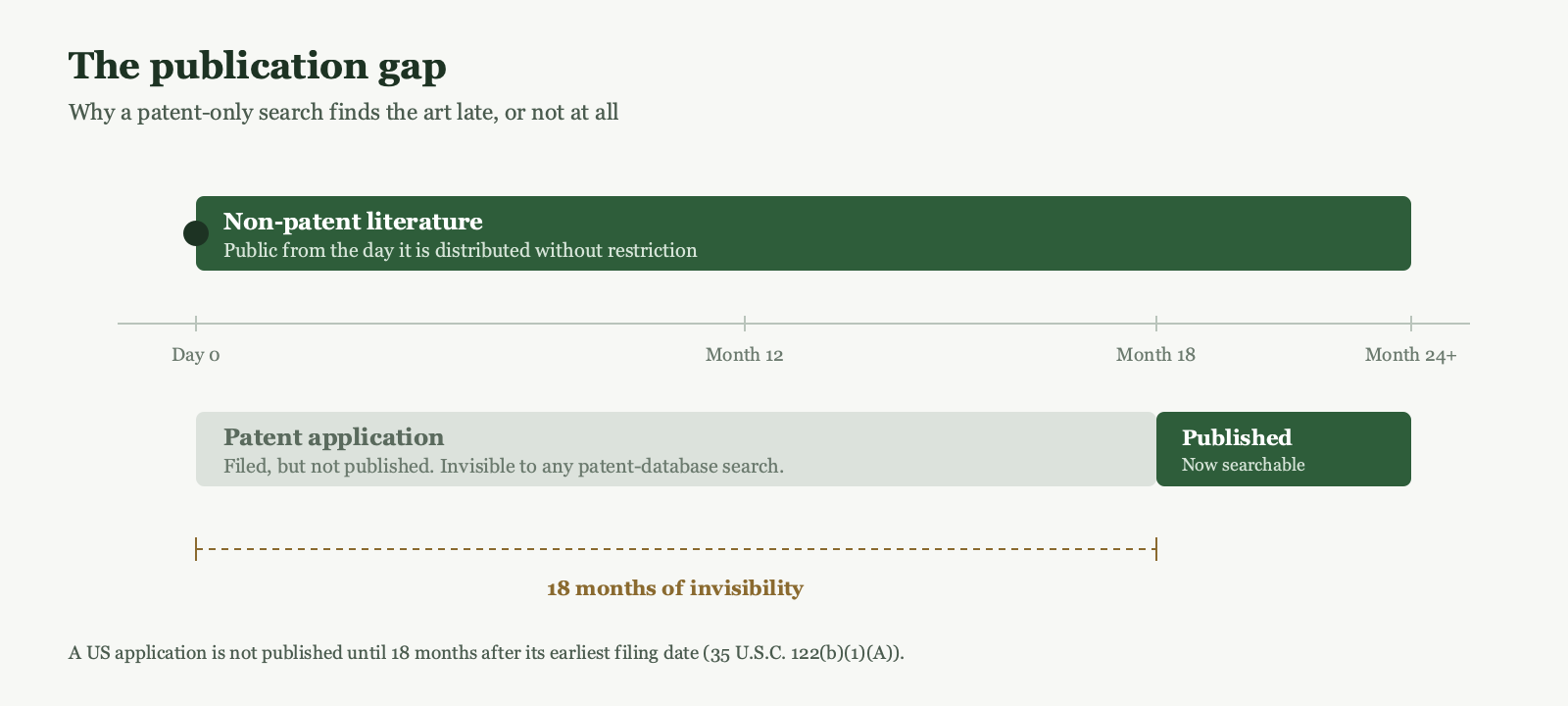
A US application is not published until 18 months after its earliest filing date, so a patent-database search cannot see it during that window.
A patent application is not published until 18 months after its earliest filing date (MPEP 1120, citing 35 U.S.C. 122(b)(1)(A)). A conference paper disclosing the same subject matter is public the day it is handed out.
That gap is the whole problem. For a year and a half, the patent record shows nothing while the technical record shows everything.
A preprint or standards contribution can anticipate a claim even when the later patent family looks clean. Breadth decided without that earlier date tends to overreach, then collapse under amendment pressure.
Cross-domain terminology
Scholarly and standards sources index concepts with vocabulary that patent classification schemes do not mirror. A search built only on the CPC groups selected at intake will miss art that describes the same mechanism under clinical, software, or standards terminology. Semantic expansion across NPL corpora is therefore a patentability control, not a nice-to-have.
Enabling detail that shapes written description and scope
NPL frequently supplies data, process parameters, and implementation choices absent from patent abstracts. That detail affects two decisions at once: whether a reference is enabling prior art against the claims, and whether the application’s own written description and figures will support the breadth counsel wants. Ignoring NPL therefore risks both novelty hits and self-inflicted support gaps.
Under European practice, the EPO Guidelines for Examination G-IV, 1 define the state of the art as everything made available to the public by written or oral description, by use, or in any other way before the filing date, without restriction on geography, language, or manner. That breadth is why oral presentations, standards contributions, and web disclosures belong in the same analysis as patents.
Major NPL Source Types and Verification Requirements
Verification takes three showings: public availability before the relevant date, enabling disclosure under the applicable law, and the exact technical teaching relied on.
Abstracts, machine translations, and search snippets are leads. Nothing more.
Academic and journal sources
Retrieve the full text and the version of record. Confirm online-first versus issue publication dates when either could fall on different sides of the critical date. Do not treat a citing sentence in a later review article as a substitute for the primary paper.
Standards
Check version history, approval dates, and draft status against the invention date. Intermediate contributions may be publicly accessible even when the approved standard issues later. Record the document number, working-group identity, and the channel through which the text was available.
Theses, conference material, and preprints
Confirm the public availability date and whether the disclosure is enabling. Catalog records, repository deposit receipts, and conference programs help, but the legal question is accessibility to interested skilled persons exercising reasonable diligence.
Software and web sources
Document timestamps, repository commits, release tags, and archived page captures. Preserve hash or commit identifiers where possible. Treat product marketing pages and secondary blogs as pointers to primary technical artifacts, not as the artifacts themselves.
The legal test is worth stating exactly.
Under U.S. practice, USPTO MPEP 2128 treats a reference as a printed publication when it was disseminated or otherwise made available to the extent that persons interested and ordinarily skilled in the subject matter, exercising reasonable diligence, can locate it.
That is the standard the six conference copies met. MPEP 2128 also discusses standards-body contributions as potentially publicly accessible, consistent with M&K Holdings v. Samsung Electronics, 985 F.3d 1376 (Fed. Cir. 2021).
The bar sits lower than most teams assume when they wave off a conference handout or a working-group upload.
Common Gaps When NPL Is Treated as a Separate Report
Disconnected NPL work fails less often because the sources were never found, and more often because the findings never touched the claim set while language was still movable.
Findings arrive after claim lock
When NPL lands after independent claims are settled, counsel is left with amendment theater instead of strategy. Fallback positions that should have been designed in become hurried dependent claims. Scope that should have been narrowed at the strategy gate becomes a prosecution problem.
Terminology never gets reconciled
Scholarly and standards vocabulary rarely matches first-draft claim terms one-for-one. If that mismatch is discovered only in a static PDF report, nobody rewrites the claim glossary, the glossary-to-spec mapping, or the figure callouts. The application then describes the invention in one dialect while the closest art uses another, which complicates both examination and later enforcement.
Technical gaps stay outside the disclosure
NPL often reveals missing parameters, unstated operating ranges, or alternative embodiments the inventors contemplated but never wrote down.
Feed those gaps back into the invention record before drafting, or the specification will not support the claim positions counsel still wants. The risk is not only prior art. It is written-description and enablement damage the team does to itself.
Provenance dies in the report
Date verification, archive captures, and enabling excerpts documented only in a search memo are hard to reuse when claims change, figures are planned, or a later opinion must explain what was considered. The reproducibility work should travel with the matter, not sit in a parallel folder.
No search proves a negative. Even a wide patent-plus-NPL effort leaves residual uncertainty. A defensible patentability opinion states what was searched, what was verified, what could not be verified, and how those limits affected claim scope. Pretending completeness is a larger professional risk than recording the boundary.
Integrating NPL Findings into Claim Strategy and Drafting
The fix is structural, not procedural: treat NPL as an input to claim strategy, not a checklist item after the search.
Prior-art analysis for patentability, invalidity, freedom to operate, landscape, white-space, or state-of-the-art questions can run as a dedicated professional engagement. The same classes of findings can also run inside a live drafting matter, informing the draft before claims are approved.
Either way, one thing decides the value: whether a verified disclosure still reaches claim language that can change.
Map disclosures to claim elements while claims remain editable
For each material NPL hit, identify the claim elements it teaches, suggests, or fails to combine. Mark where a limitation still distinguishes the art, where a fallback should be promoted, and where an unsupported assumption in the invention disclosure needs inventor input. This mapping belongs before the claims gate, not after first-filing panic.
Test breadth and fallback positions against the earliest enabling dates
Use the earliest verified enabling NPL date as a stress test for independent claims. If a 14-month-old standards contribution already shows feature A plus feature B, the strategy discussion should address whether feature C is real, supported, and worth the commercial tradeoff. Breadth without a dated distinction is not ambition; it is deferred amendment.
Carry citations into specification support and figure planning
Verified excerpts and technical gaps should inform what the specification must teach and what the figures must show. If NPL forces a narrower range, the examples, embodiments, and drawings should make that range visible and supported. If NPL reveals an alternative the inventors used internally, decide deliberately whether to disclose it.
Keep an auditable link from limitation to support or distinction
Each claim limitation should point to invention material that supports it, to NPL that forced its presence, or to both. That provenance is what lets counsel revise claims without re-deriving the search narrative from memory.
A decision-gated workflow keeps those links inside the matter. Counsel still owns Intake, Strategy, Claims, Specification & Figures, and Sign-off.
Between the gates, production work assembles search rounds, clusters NPL with patent art, and surfaces gaps for professional decision. Prior Art Radar is the prior-art intelligence that feeds those findings into claim strategy inside the same matter, so a dated NPL excerpt sits beside the claim element it affects instead of in a separate memo.
That analysis is available as a separate engagement, and it also runs inside a live drafting matter where it informs the draft in that same matter.
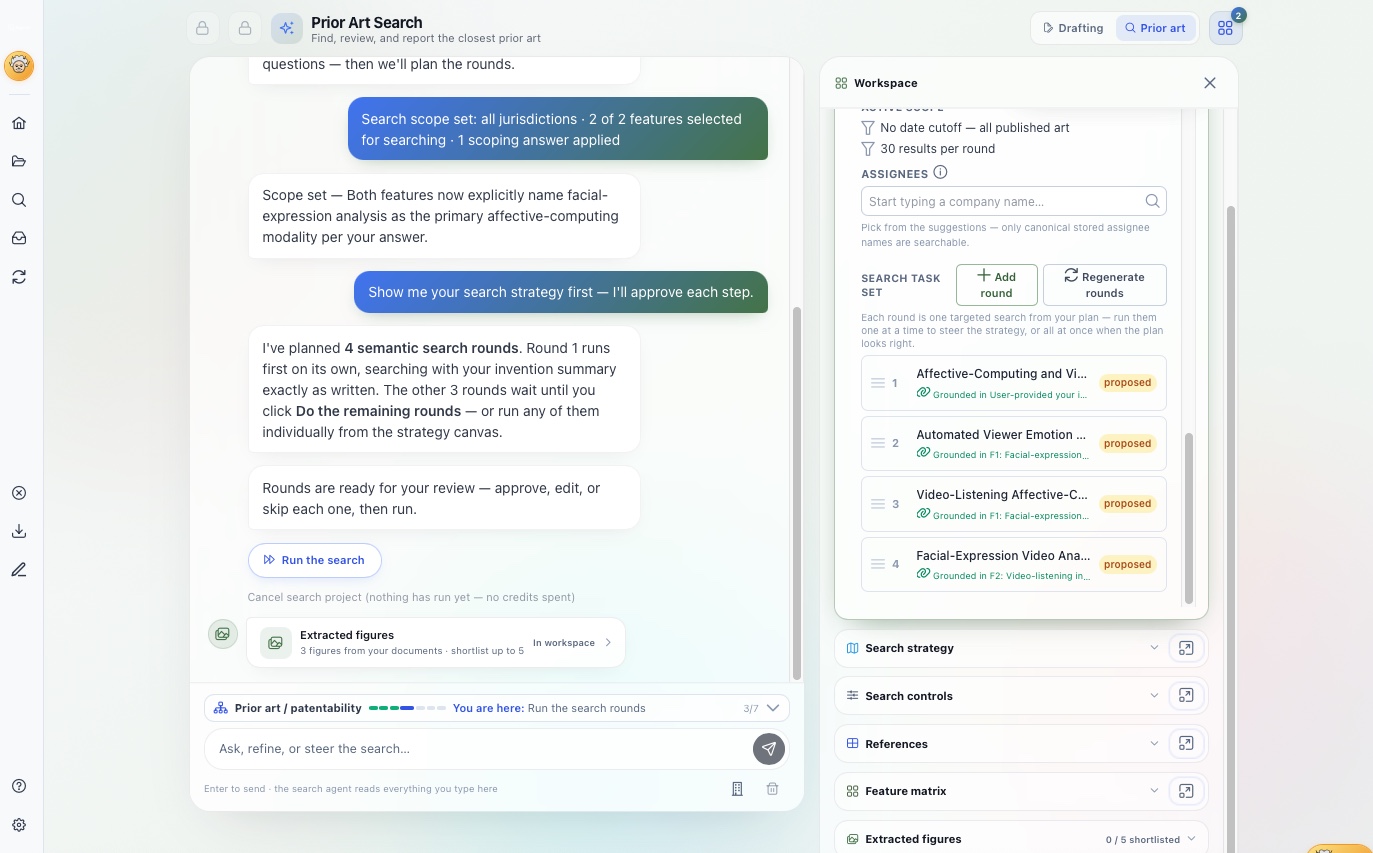
Figure: Search-rounds workspace used to compare parallel patent and NPL iterations, record public-availability dates, and map enabling excerpts to claim elements before the claims gate.
On a review pass, each search round reads as a dated bundle: queries run, patent and NPL hits kept, near-misses discarded, and the claim chart cells those hits touch.
Then a standards contribution lands with an earlier public date than the closest patent family. The chart cell for that limitation flips from “distinguished on date” to “needs structural or parametric distinction.”
That flip is the moment to revisit breadth, and it is worth far more before the Claims gate than after.
The workspace approves nothing. It makes the evidence legible at Strategy and Claims so the decision is informed rather than retrospective. NPL changes outcomes only when the record that proved public availability also constrains claim language before Sign-off.
Conclusion
The work is not finished when a list of papers is attached to a memo.
It is finished when each material disclosure has a verified date, an enabling reading, a mapped claim consequence, and a route into specification support, while counsel can still change the claims.
Six copies at a conference were enough to make prior art in 1985. The question worth asking about your own last filing is a simple one: would that paper have turned up before the claims were locked?
Esgenix is a decision-gated agentic patent workflow platform for patent professionals, built so those findings reach strategy and drafting inside the same matter under attorney-controlled gates. Request a demo to benchmark that search-to-claim path on a real disclosure.
Frequently Asked Questions
How do I find non-patent literature for a patentability opinion?
Search field-appropriate academic databases, standards repositories, conference proceedings, preprint servers, and archived web or code sources. Verify public availability date and enabling disclosure on the full text, then map each material reference to specific claim elements before claims are locked.
What does a thorough prior art search include?
A thorough search covers patent documents and non-patent literature, verifies dates and technical content against the critical date, reconciles cross-domain terminology, and feeds findings into claim strategy and specification support while the claim set remains editable.
How can I speed up prior art review for a patentability opinion?
Run patent and NPL searches in parallel, rank by earliest enabling date, map survivors directly to claim elements, and keep verification artifacts in the same matter record so later drafting does not restart provenance work.
How can I be confident I haven't missed relevant prior art?
You cannot prove a negative. Confidence comes from documented source coverage, dated verification, explicit residual gaps, and claim scope that reflects the earliest enabling disclosures actually found.
What's the quickest way to do a novelty assessment?
Combine patent and NPL searching in one workflow, verify public-availability dates on the closest hits first, and stress-test independent claims against those dates before investing in full specification drafting.
See it on your own use case
Related articles
State of the Art Search: How an Agentic Survey Argues With Itself
Learn how an agentic state of the art search uses specialist AI agents to cross-check findings and inform patent claim strategy before professional review.
Esgenix Team · Oct 15, 2026 · 9 min read
Patentable Enough to File: The Check That Happens Before Drafting Starts
Assess whether an invention is patentable enough to file before drafting begins using a six-check framework covering prior art, eligibility, and disclosure support.
Esgenix Team · Oct 15, 2026 · 11 min read
How to Prepare an Information Disclosure Statement and Keep IDS Records Accurate Across a Patent Portfolio
Learn how to prepare a compliant information disclosure statement (IDS) and maintain accurate prior-art records across a patent portfolio under USPTO rules.
Esgenix Team · Oct 15, 2026 · 8 min read