The AI Patent Workflow, Step by Step: Where the Handoffs Cost You
Esgenix Team · Published August 17, 2026 · Updated September 4, 2026
On this page
You have probably already run the evaluation. A shortlist for intake, a different shortlist for search, another for drafting, another for analytics, and a spreadsheet reconciling which of them will talk to the others. That evaluation asks the wrong question. A patent application is not eight independent tasks performed in sequence. It is one argument, assembled once, that has to survive an examiner who reads the claims against the art and then reads the specification for support. An AI patent workflow built as eight separate purchases optimizes each step and loses the thing that connects them. This article walks the workflow stage by stage, says plainly what each stage actually needs, and identifies where the handoffs between stages cost you quality rather than time.
The eight stages, and the seams between them
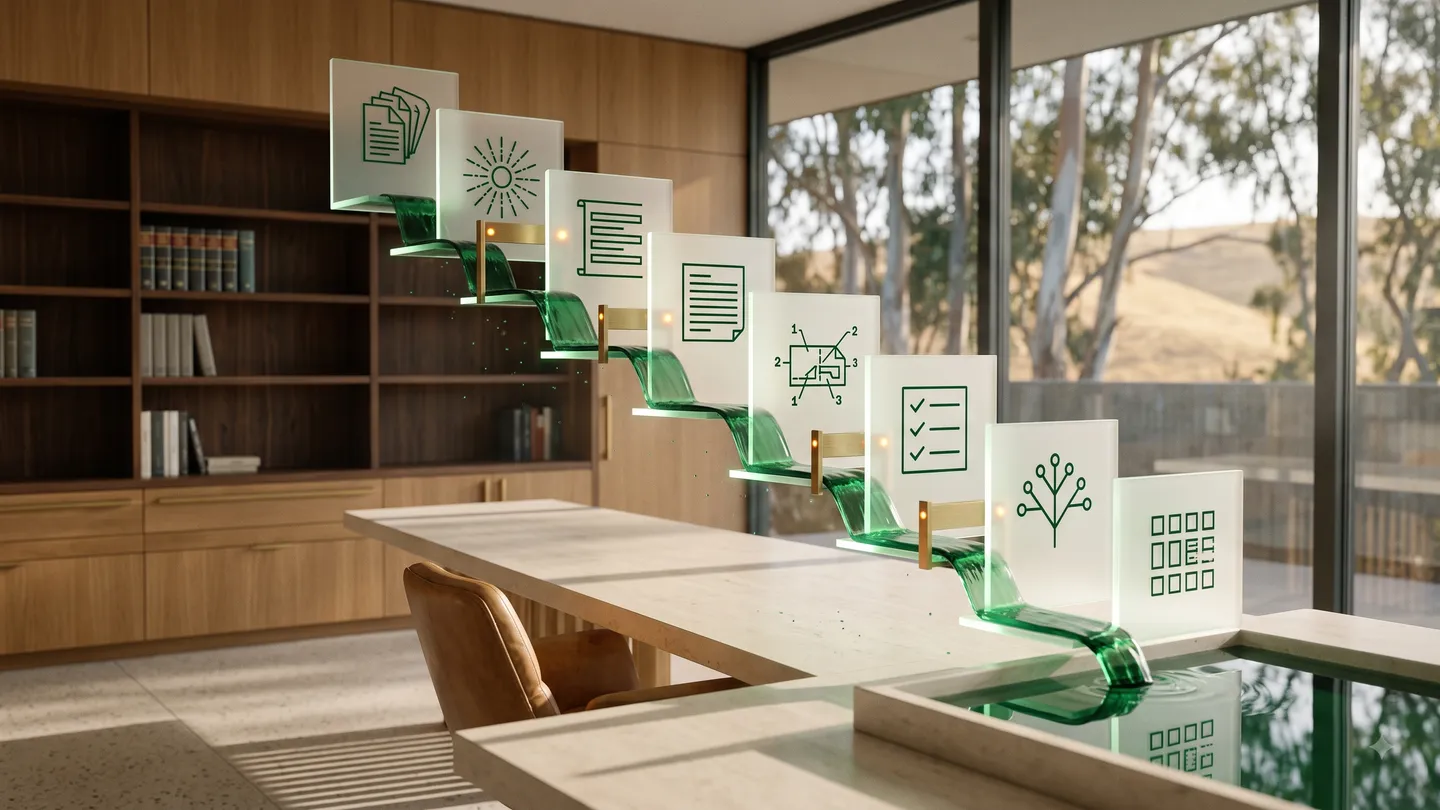
Invention capture. The disclosure arrives incomplete. An inventor describes a result and omits the mechanism, or uses a term of art in a private sense. Whatever is missing here is missing everywhere downstream, and it usually surfaces three weeks later as an email asking the inventor a question you should have asked on day one. Prior art search and novelty. You need to know what the claims must clear before you write them, not after. In most workflows the search is a deliverable (a report, a set of PDFs) and the drafter then reads that report and holds it in their head while writing. Claim drafting. Scope is the whole commercial question. Broad enough to be worth owning, narrow enough to survive, with fallback positions layered underneath in case the primary claim does not hold. Specification and figures. The description has to support every claim element, and the figures have to illustrate the features that distinguish the invention. Reference numerals have to match the text. This is where most of the hours go and where most of the tedium lives. Pre-filing checks. Antecedent basis, clarity, support under 35 U.S.C. §112 for a US filing, added-matter discipline for the European counterpart. Prosecution. Amendments and arguments grounded in the file wrapper. Freedom to operate and analytics. Clearance, invalidity, claim charts. Portfolio and landscape. The long view. Several products cover several of these stages, and describe themselves in their own materials as doing so: DeepIP, Solve Intelligence, Ankar, Qthena, Patlytics and PatentPal all publish their coverage, and it is worth reading what each of them claims for itself. Breadth across the lifecycle is a legitimate bet, and for some teams it is the right one. Esgenix has made a different bet: depth in the drafting core, where the granted claim is actually determined. Here is the argument for that bet. Look at the seams above. Search finishes and produces a report; drafting starts and a human carries the report across. Claims finish; the specification is written to support them, by hand, element by element. The specification finishes; figures are commissioned from a draughtsman working off a sketch, and someone reconciles the numerals afterwards. Every one of those seams is a re-entry point where context is retyped, summarized, or forgotten. The stack does not lose time at the seams. It loses fidelity.
What an agentic patent workflow does instead
First, the vocabulary, because it is used loosely everywhere else. An agent here means a piece of software given a defined job, the tools to do it, and a standard to meet. It does the job and reports back, rather than waiting for the next instruction. Esgenix runs several of these, on different underlying models chosen for what each is good at. One searches. One drafts claims. One writes the description. One produces the figures. One grades the result. This is the difference that matters when you compare products. Patent AI is moving from assistance toward workflow execution. An assistance-shaped tool sits beside you while you write and suggests the next passage, the next paragraph, the next amendment. You remain the drafter; the tool makes you faster at drafting. Esgenix runs the production work itself and stops at defined points for your decision. You remain the attorney; the tool removes the assembly. The difference shows up in where you sit in the process. Where a tool is shaped around assistance, you stay present through the drafting itself. With Esgenix, you make five decisions and the platform does the production between them. Those five decisions are gates, and nothing passes one without you. Gate one, intake. You confirm the invention as the platform has understood it, answer the technical gap flags, and set jurisdictions: US, European, Indian practice, natively. Gap detection means the platform reads the disclosure and tells you what is missing: an unexplained step, an undefined term, a result asserted with no mechanism. It also proposes how to close each gap. The inventor question you would have sent in week three gets asked in hour one. Gate two, strategy. You set claim breadth on the scope slider: an on-screen control that widens or narrows the claim set as you drag it, re-checking support against the disclosure at each position. Breadth becomes something you explore in seconds and see the consequences of, rather than something you reason about in the abstract and then draft by hand to test. Gate three, claims. You approve or amend the claim set. Nothing proceeds without this. Gate four, specification and figures. You review the draft with provenance visible on every claim element. Provenance means each element carries an identifier pointing back to the passage of the invention disclosure it came from, so you verify support by following a pointer rather than by reading the disclosure again alongside the draft. Gate Five, Sign-off. A natural person has to approve of the draft and only then it is downloaded as Docx and PPtx. Human involvement is not reduced. It is relocated: off paragraph assembly and support-checking, onto the decisions that determine what the patent is worth.
Depth, shown rather than asserted
The claim that drafting depth is the harder position needs evidence, so here is what it looks like in practice. The prior art search covers 220 million documents across 108 jurisdictions and matches on meaning rather than keywords: semantic search, which means the system compares what a passage says to what your invention does, so it finds the relevant disclosure that never uses your vocabulary. The important part is not the coverage figure. It is that the search output feeds the drafting agents in the same session. The claim set is positioned against the closest art from the first draft. The specification carries fallback positions where the art is dense. The figures illustrate the features that do the distinguishing. Better search does not just produce a faster search. It produces a better claim set, a better specification and a better figure set. Figures are generated with no baseline drawing required. The system reads the specification, decides what the figure set should be, draws it, and reconciles every reference numeral against the text. The common approach elsewhere is to convert an uploaded sketch, photo or CAD file: a different starting point, which produces figures that illustrate what the inventor drew rather than what the specification claims. Freedom-to-operate analysis and white space analysis run inside the same session as the drafting, not as a separate report from a separate vendor arriving weeks later. And an independent model grades the finished draft against the standards a senior patent attorney would apply, sending it back to be rewritten when it fails: LLM as a judge, a quality gate. It catches the flat, generic texture that machine-written prose falls into, and the substantive defects underneath that texture. Esgenix has completed ISO 27001 Stage 1, covering the handling of invention and client data. For an in-house team putting unfiled disclosures into a vendor system, that is usually the second question after quality.
One table, on operating models
| Stage | The assistance pattern | The Esgenix pattern |
|---|---|---|
| Search to claims | Search produces a report; a human carries it into drafting | Search output feeds the claim agent in the same session |
| Claim scope | Explored by drafting alternatives by hand | Explored on the Scope Slider, support re-checked at each position |
| Claims to specification | Attorney writes support element by element | Description drafted against the approved claim set, provenance attached |
| Figures | Converted from an uploaded sketch or CAD file | Derived from the specification, numerals reconciled to the text |
| Professional's role | Present through the drafting itself | Decides at five named gates |
| Commercials | Per-seat annual license | Per matter delivered, across tiers |
That last row is structural, not a discount. Per-seat licensing prices your headcount. Outcome-driven pricing prices your filings. If your filing volume and your attorney count move independently, and in most corporate IP departments they do, the two models produce very different numbers over three years, and only one of them tracks what you are actually buying.
How to decide
Weight the stages by their effect on the granted patent, not by how many of them a vendor covers. Portfolio dashboards are useful. They do not change what issues. Claim scope and the support behind it do. Then count seams. For each candidate architecture, ask how many times a human re-enters context that the previous stage already had. That number is a good proxy for where your quality will leak. Then ask every vendor the instruction-count question. How many separate instructions does one application take, and is the attorney present for all of them? The answer tells you which operating model you are buying, regardless of how the product is described.
A specific next step
Take the last application you filed. Count the tools that touched it, and the number of times someone re-keyed or re-verified something a previous stage already knew. Then bring that same invention disclosure to a working session with us. Run it through, and compare the claim set, the figure set and the per-element provenance against what you filed by hand. The comparison is more informative than any demonstration on our sample invention.
Frequently Asked Questions
Do I need one AI patent platform or a stack of specialist tools?
It depends on which stages carry your risk. A broad platform reduces integration effort across the lifecycle. A specialist gives you depth where the granted claim is determined. Most teams find that claim scope and the support behind it deserve more weight than portfolio reporting, because only one of those changes what issues.
Where does AI improve patent quality rather than just speed?
At the connections between stages. When the prior art search output feeds the claim agent directly, the claims are positioned against the closest art from the first draft and the specification carries fallbacks where the art is dense. When figures are derived from the specification rather than from an uploaded sketch, they illustrate the distinguishing features and the reference numerals reconcile to the text.
Does using AI to draft a patent application have to be disclosed to the USPTO?
There is no general duty to disclose that AI assisted with drafting. What the USPTO requires is a natural person's signature on filed papers, and that signature carries a personal duty of reasonable inquiry into the contents. The duty of disclosure concerns material prior art, not the tools used to prepare the document. Check current USPTO guidance for your specific filing.
How many attorney hours does an agentic workflow actually remove?
It does not remove attorney involvement; it relocates it. Paragraph assembly, support checking element by element, and numeral reconciliation come off the attorney's desk. Five decisions stay on it: intake and gap resolution, claim strategy, claim approval, review of the specification and figures with provenance visible, and signature.
What does "agentic" mean in a patent drafting context?
An agent is software given a defined job, the tools to do it, and a standard to meet: it completes the job and reports back rather than waiting for the next prompt. In an agentic patent workflow, separate agents search the art, draft the claims, write the description, generate the figures, and grade the result, and the attorney approves at each gate rather than instructing each step.
More on drafting workflow: Explore Patent Drafting
See it on your own use case
Related articles

One Disclosure, Three Standards: AI Patent Drafting for the USPTO, EPO and Indian Patent Office (IPO)
One disclosure, three standards. What the USPTO, EPO and Indian Patent Office each require, and how to draft for all three without three drafts.
Esgenix Team · Aug 17, 2026 · 9 min read
What an Agentic Council of AIs Means for Patent Drafting
An agentic council uses multiple LLMs to debate and draft patents with explainable redline trails, secure storage options, and attorney oversight.
Esgenix Team · Jul 14, 2026 · 5 min read

Why You Should See How an AI Drafted Every Claim
Opaque AI patent tools create hidden risks. Learn why visible claim-generation logic and audit trails are essential for compliance and defensibility.
Esgenix Team · Jul 14, 2026 · 4 min read