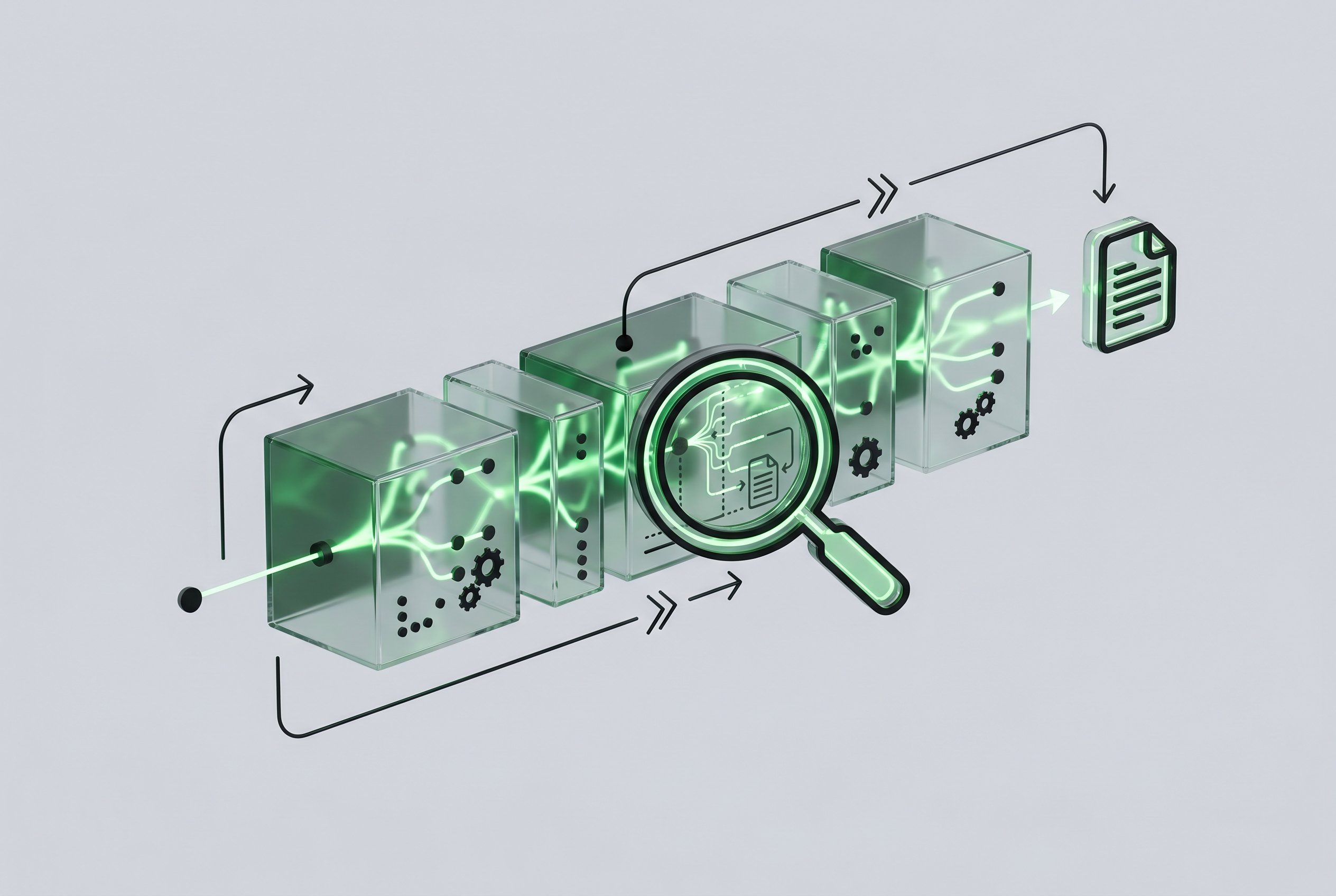
Patent attorneys should be able to see how an AI drafted every claim because the legal question is not whether the text sounds plausible. The question is whether each limitation is supported by the inventor's disclosure, reviewed by the attorney, and traceable before filing, which matches the USPTO's emphasis on practitioner responsibility for AI-assisted work.
A black-box draft creates two review burdens at once: counsel must check the legal strategy and reconstruct where the technical language came from. ABA Formal Opinion 512 warns that generative AI tools can produce inaccurate output and that lawyers cannot rely on it without an appropriate degree of independent verification or review.
What does explainability mean for patent claims?
In patent drafting, explainability means every claim limitation can be traced to source disclosure, attorney strategy, prior-art context, or a recorded review decision. That matters because the written-description standard in USPTO MPEP § 2163 asks whether the specification shows possession of the claimed invention, which is hard to verify if the AI cannot show where a limitation came from.
Explainability is also a confidentiality control because the same audit trail that shows claim provenance can show where sensitive data was processed and whether it left attorney-controlled infrastructure.
Why are polished black-box drafts not enough?
A polished draft can hide unsupported embodiments, overbroad claim language, inconsistent terminology, or limitations that never appeared in the inventor's disclosure. Baker Donelson's 2026 guidance on AI-assisted patent drafting identifies written-description risk when generative AI contributes technical detail that may not reflect inventor possession. Black-box tools also slow senior review because the attorney must reverse-engineer the draft before improving it. IPWatchdog's discussion of AI claim drafting compared AI output to work that still requires experienced practitioner revision, which is precisely why visible reasoning and redline provenance have practical value.
What should a redline audit trail show?
A useful audit trail should show the original disclosure text, the proposed claim language, the model or agent that suggested the change, the reason for the change, and the human reviewer's decision. That record supports the USPTO's AI guidance because it creates evidence that the practitioner reviewed and controlled the final work product. For international filings, the trail should also preserve why certain scope choices were made before publication or filing. The EPO's Article 54 EPC prior-art rule treats what was made available to the public before filing as prior art, so counsel needs both confidentiality discipline and a record of what the application actually disclosed at filing.
How does Esgenix make AI drafting reviewable?
Esgenix is an agentic patent workflow platform powered by a multi-LLM council that debates claim scope, surfaces antecedent-basis and support issues, and produces redline audit trails that patent professionals can review. The council is the engine, and the product is the end-to-end workflow around it: claim strategy, prior-art, novelty, and inventiveness checks, antecedent-basis review, infringement and evidence-of-use analysis, drawings, and grant-ready drafts. Its Scope Slider, Prior Art Radar, Examiner's Lens, and Patent Counsel Digital Twin are meant to make the drafting process explainable rather than merely faster.
The important product distinction is that Esgenix is not positioned as a replacement for patent attorneys. It is a drafting and prosecution-support platform for patent professionals, and the value of the redline trail is that it keeps attorney judgment visible throughout the claim-composition process.
What should reviewers ask before approving AI-generated claims?
The first review question is whether each independent claim limitation appears in the inventor's disclosure or is a legally supportable abstraction from it. USPTO MPEP § 2163 makes possession of the claimed invention the central written-description inquiry, so an AI draft should expose support mapping before an attorney approves claim scope.
The direct buyer question is whether the tool can map generated claims to the invention disclosure. A useful answer is yes only if every generated claim limitation has a visible support link to disclosure text, prior-art context, or attorney instruction. USPTO MPEP § 2163 makes that support mapping central because written description turns on possession of the claimed invention.
For quality benchmarking, the useful metrics are not only readability or speed; they include unsupported limitation count, antecedent-basis issues, source-mapping coverage, attorney override rate, and whether hallucinated technical facts are caught before filing. ABA Formal Opinion 512 requires independent verification of AI output, which makes these review metrics more defensible than vague accuracy claims.
The second review question is whether the AI introduced facts, embodiments, or performance assertions that were not in the disclosure. ABA Formal Opinion 512 warns that generative AI output can be inaccurate and requires independent verification, which makes unsupported technical additions a drafting issue and an ethics issue at the same time.
The third review question is whether confidential inputs stayed in an approved environment throughout drafting. Consumer and enterprise AI services differ in how they handle model improvement, retention, and human review, so patent teams should require clear answers on each of those pathways before sending client disclosures to any AI workflow.
To see an explainable, redline-auditable drafting workflow in practice, book a demo with Esgenix.
Frequently asked questions
What does explainable AI mean in patent drafting? It means generated claims carry visible provenance to disclosure text, prior-art context, strategy rules, and attorney edits, the kind of possession-of-the-invention support that USPTO MPEP § 2163 is concerned with.
Do black-box AI tools create validity risks? They can: as Baker Donelson's 2026 guidance notes, unsupported technical detail can trigger written-description questions if the final specification does not show inventor possession of the claimed invention. How do audit trails help confidentiality? Audit trails help show where sensitive disclosure data was processed and whether the workflow avoided the provider-side human review or model-improvement use that many consumer AI services allow.
Is full transparency required by the USPTO? The USPTO does not prescribe one product architecture, but its 2024 AI guidance makes practitioner review and responsibility central for AI-assisted work.